
43 Broadway, Arlington, MA 02474. Monday–Saturday, 9 a.m.–5 p.m.
Click to Call: (781) 641-0500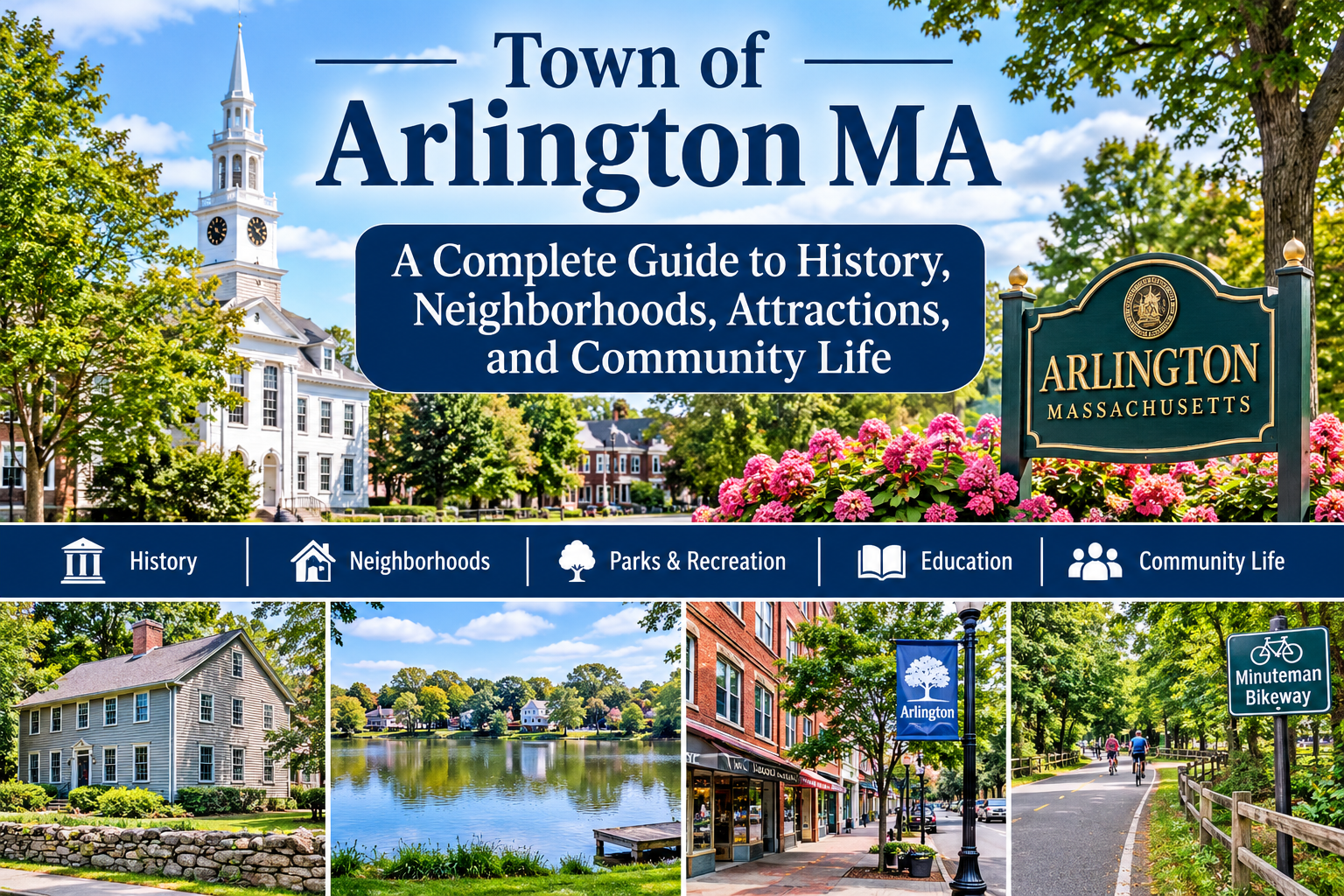
The Town of Arlington MA is a historic and welcoming community in Middlesex County, Massachusetts, located approximately six miles northwest of Boston. Known for its New England character, established residential neighborhoods, local businesses, parks, schools, and cultural attractions, Arlington offers a combination of suburban comfort and convenient metropolitan access.
Whether you are a longtime resident, a new homeowner, a visitor exploring the Boston area, or someone researching communities in Greater Boston, Arlington has plenty to discover. The town has a history stretching back to the 1600s, but its identity is not limited to historic landmarks. Today, Arlington is also known for its walkable commercial areas, independent restaurants, community events, public libraries, recreational facilities, and active neighborhood organizations.
One of Arlington’s distinguishing features is how its historic and modern elements coexist. Residents can visit a Revolutionary War-era house, enjoy a performance at a local theater, walk beside Spy Pond, explore an independent shop, or cycle along the Minuteman Bikeway. These experiences help make the community appealing to people with different interests and lifestyles.
This guide covers the town’s history, location, government, neighborhoods, education, parks, cultural attractions, transportation, local businesses, and community resources. It also explains how residents can find useful town services and enjoy everyday life in Arlington.

Arlington is located in Middlesex County in eastern Massachusetts. It sits northwest of Boston and shares borders with several Greater Boston communities, including Cambridge, Somerville, Medford, Winchester, Lexington, and Belmont.
Its location makes Arlington convenient for people who work, study, or spend time in Boston and nearby cities. Massachusetts Avenue is one of the town’s primary commercial and transportation corridors, connecting different neighborhoods and business districts.
The town covers approximately 5.5 square miles, including land and water. According to the Town of Arlington’s FY2026 community profile, Arlington had a population of 46,308 in the 2020 Census. The profile describes the town as a compact community with a mix of residential neighborhoods, retail areas, and access to public transportation.
Arlington’s location provides access to several nearby destinations:
For residents, these nearby communities expand the range of available services and activities without making Arlington’s own town center any less important.

Arlington has a long history that predates its current name and municipal identity. Understanding that history helps explain the town’s historic buildings, public spaces, street patterns, and cultural landmarks.
The area now known as Arlington was originally settled by English colonists in 1635 as a village called Menotomy. The name is associated with the area’s Indigenous history and is often interpreted as referring to swift-running water.
In 1807, the community was incorporated as West Cambridge. In 1867, it adopted the name Arlington, honoring the heroes buried at Arlington National Cemetery in Virginia.
Arlington’s history also includes the Indigenous Massachusett people, whose ancestral territory includes the land on which the town is located. The Town of Arlington acknowledges this history through its land acknowledgment and historical resources.
One of the most important events in Arlington’s history took place on April 19, 1775, during the opening day of the American Revolution.
At that time, the community was still known as Menotomy. Local militia members and other Patriots confronted British troops during the British retreat from Concord and Lexington. Significant fighting took place in the area, and the Battle of Menotomy became an important part of the town’s historical identity.
The Jason Russell House is one of the best-known landmarks associated with this event. The historic house provides visitors with a connection to the people and events of the Revolutionary period.
Arlington was not always the primarily residential community it is today. In earlier centuries, agriculture and small industries played important roles in its economy.
Mill Brook provided waterpower for mills and other industrial operations. At one point, several mills operated along the brook. Farmers from surrounding communities also brought grain to local mills for processing.
Spy Pond supported another historical industry. During the nineteenth century, ice was harvested from the pond and transported to other markets. Arlington was also known for its market gardens and greenhouses, which supplied produce to customers beyond the town.
As transportation improved and the Boston metropolitan area expanded, Arlington gradually developed into a more suburban community.
Visitors interested in Arlington’s past can explore several local landmarks:
These places help preserve Arlington’s architectural, artistic, industrial, and Revolutionary War history.

The Town of Arlington MA operates through a representative municipal government. Its structure includes an elected Select Board, a professional Town Manager, and a Representative Town Meeting.
Understanding how the town is governed can help residents follow local decisions and participate in community affairs.
Arlington’s Select Board consists of five elected members. The board provides policy direction and has responsibility for important municipal decisions.
Its work may involve:
Residents can follow Select Board meetings and review meeting materials through the town’s official website.
The Town Manager is responsible for the daily administration of municipal operations. The position connects policy decisions with the practical work of town departments.
Municipal administration can involve budgeting, public services, staff management, infrastructure, and coordination between departments.
Arlington uses a Representative Town Meeting as its legislative body. The town’s FY2026 community profile describes a 252-member representative body, with members representing the town’s precincts.
Town Meeting considers local matters such as budgets, bylaws, appropriations, and other issues that affect the community.
Residents who want to become more involved can learn about their precinct, attend public meetings, review town warrants, and follow local election information.

Arlington Town Hall is an important center for municipal administration and public services.
Town Hall address:
730 Massachusetts Avenue
Arlington, MA 02476
Main phone: (781) 316-3000
Residents can use the Town of Arlington’s official website to find information about departments, public meetings, municipal forms, local regulations, taxes, elections, permits, and community programs.
Residents may need to contact the town for information about:
Before contacting Town Hall, identify the type of service you need. The town website provides department listings and information about municipal responsibilities.
For example, questions about building permits should go to the appropriate building or inspection office, while questions about public streets and maintenance may belong with Public Works.
For time-sensitive matters, confirm the department’s current contact information and office hours directly with the town. Municipal schedules can change during holidays, special events, and seasonal periods.

Arlington has several recognizable neighborhoods and commercial areas. Each has its own atmosphere, local businesses, residential streets, and access to community facilities.
East Arlington is located near Cambridge and Somerville. Its position makes it a convenient area for people who travel toward Boston or use nearby public transportation connections.
The neighborhood includes residential streets, restaurants, shops, and access to Spy Pond and other open spaces.
Massachusetts Avenue is an important commercial corridor in this part of town. Residents and visitors can find cafes, neighborhood services, and independent businesses.
Arlington Center is one of the town’s main civic and commercial districts. It includes Town Hall, Robbins Library, local restaurants, shops, cultural organizations, and historic sites.
The area is a useful starting point for exploring Arlington because several attractions are within walking distance of one another.
Visitors can combine a trip to the library with a walk through the Town Hall Memorial Garden, a meal at a local restaurant, or a visit to a nearby cultural destination.
Arlington Heights is located in the western part of town. It includes residential neighborhoods, local businesses, and access to parks and outdoor recreation.
The area offers a different atmosphere from the busier commercial sections closer to Cambridge. Its streets include a mixture of housing styles and neighborhood services.
Residents can use local bus routes and nearby road connections to travel to other parts of Arlington and surrounding communities.
The Brattle and Pleasant Street areas include residential streets and connections to local commercial districts. These areas provide access to neighborhood services, schools, recreation, and major roads.
For anyone researching a home or apartment in Arlington, it is helpful to explore the surrounding streets rather than relying only on a neighborhood name. Walking the area can provide a better sense of traffic, sidewalks, nearby parks, and everyday convenience.

Arlington offers activities for residents and visitors throughout the year. Its attractions include historic sites, public art, parks, theaters, independent shops, and outdoor recreation.
The town’s Cultural District connects many of these destinations along Massachusetts Avenue, extending from Capitol Square in East Arlington toward Arlington Center.
The Jason Russell House is one of Arlington’s most significant historic landmarks. It is associated with the fighting that took place in Menotomy on April 19, 1775.
Visitors interested in Revolutionary War history can learn about the events of that day and the experiences of people who lived in the area.
Before planning a visit, check the historic site’s current schedule, tour availability, and admission information.
The Cyrus Dallin Museum celebrates the work and legacy of sculptor Cyrus Dallin, who lived and worked in Arlington.
The museum provides an opportunity to learn about the artist’s career and contributions to American sculpture.
Art enthusiasts can combine a museum visit with other cultural attractions in Arlington Center.
One of Arlington’s notable public artworks is the Menotomy Indian Hunter, a sculpture by Cyrus Dallin.
The sculpture is located in the garden area near Robbins Memorial Town Hall and Robbins Library. It is an important part of the town’s public art collection.
The work should also be understood in the context of Arlington’s broader Indigenous history and the importance of respectful interpretation of historical representations.
Robbins Library is a central community resource in Arlington. Public libraries offer much more than books. They can provide educational resources, reading programs, digital services, community events, and quiet spaces for study.
Residents should review the library’s official website for current opening hours, borrowing policies, events, and available programs.
The Regent Theatre is one of Arlington’s cultural destinations. It hosts performances, entertainment, and other events throughout the year.
Checking the theater’s schedule before visiting is a good way to plan an evening around a live performance or film.
Arlington has an active arts community, with galleries, creative businesses, and organizations that support local artists.
Visitors can explore exhibitions, workshops, and special events. The town’s Cultural District is particularly useful for finding arts-related destinations.

Outdoor spaces are an important part of Arlington’s community life. Residents can enjoy walking, cycling, playgrounds, open spaces, and waterfront recreation.
The town’s new-resident guide identifies more than two dozen parks and playgrounds. Specific facilities, access conditions, and program schedules should be checked before visiting.
Spy Pond is one of Arlington’s best-known natural features. It offers a scenic setting for outdoor recreation and relaxation.
Depending on the season and applicable rules, visitors may enjoy walking near the water, observing wildlife, or spending time in nearby open spaces.
Spy Pond also has historical significance because ice harvesting once formed part of Arlington’s local economy.
When visiting, respect posted rules, protect wildlife, and avoid leaving litter behind.
The Minuteman Bikeway is a major recreational and transportation route connecting Arlington with Cambridge, Lexington, and Bedford.
The trail is used by cyclists, walkers, joggers, and commuters. It provides a way to travel through several communities while enjoying an outdoor route.
For a safe trip:
The bikeway is particularly useful for residents who want to combine recreation with transportation.
The garden near Robbins Memorial Town Hall provides a pleasant place to pause while exploring Arlington Center.
Its landscape and public art make it a useful stop for visitors interested in architecture, history, and outdoor spaces.
Arlington’s parks and playgrounds provide opportunities for children, families, and adults to spend time outside.
Before visiting a particular playground or sports facility, check whether it has age-specific equipment, accessible paths, restrooms, parking, or seasonal restrictions.
Families should also review local recreation information for registration requirements and program schedules.

Education is an important part of the Town of Arlington MA. Arlington Public Schools serves students from kindergarten through high school.
Families considering a move to Arlington should review official school information rather than relying only on third-party school rankings or general neighborhood descriptions.
The Arlington Public Schools district provides information about school locations, enrollment, academic programs, district policies, calendars, and family resources.
Parents can use the district website to find:
Arlington High School is located at 869 Massachusetts Avenue, Arlington, MA 02476.
The school serves high school students and provides academic programs, extracurricular activities, athletics, and other opportunities.
Families should consult the school’s official website for current course information, graduation requirements, calendars, and student resources.
Arlington has elementary and middle school options serving different parts of town.
School assignments, enrollment procedures, and program availability may change. Families should confirm the current attendance area and registration requirements directly with Arlington Public Schools.
When comparing schools or planning a move, consider more than a school’s general reputation.
Useful questions include:
These questions help families make informed decisions based on their actual needs.

Arlington’s location provides access to public transportation, major roads, bicycle routes, and nearby regional destinations.
The Massachusetts Bay Transportation Authority provides bus service in Arlington and connections to other parts of Greater Boston.
Alewife Station, located just outside Arlington in Cambridge, is an important nearby subway connection on the Red Line.
Residents who commute should check current MBTA schedules, route changes, service alerts, and fare information before traveling.
Massachusetts Avenue is one of Arlington’s main roads. Route 2 also provides regional access near the town.
Driving conditions can vary depending on the time of day, school schedules, roadwork, and local events.
People who are new to the area should allow extra time when traveling during weekday commuting periods.
Arlington’s sidewalks, neighborhood streets, and Minuteman Bikeway make walking and cycling practical options for some trips.
The town’s compact layout can make it possible to reach shops, restaurants, libraries, and other services without driving.
However, conditions vary by location. People should check crossings, pavement conditions, bicycle access, and route safety when planning regular trips.

Local businesses help give Arlington its neighborhood character. The town has restaurants, cafes, bakeries, specialty shops, professional offices, and personal services.
Massachusetts Avenue is a major commercial corridor, with several business areas offering different dining and shopping experiences.
Arlington’s dining options include casual restaurants, cafes, bakeries, and places for breakfast, lunch, dinner, or a quick snack.
Visitors can explore the commercial areas around East Arlington, Arlington Center, and Arlington Heights to find different types of food and local dining experiences.
When choosing a restaurant, consider:
Restaurant hours and menus can change, so check directly with the business before making plans.
Arlington has independent retailers and neighborhood shops that contribute to the local economy.
Visitors may find specialty products, gifts, clothing, home-related items, books, art, and other locally offered goods.
Shopping locally can help support small businesses and maintain the character of Arlington’s commercial districts.
Residents can also find local services such as healthcare providers, dental offices, salons, fitness businesses, repair services, and professional offices.
When choosing a service provider, review qualifications, experience, location, available services, and current customer information.

Arlington has a strong community culture supported by arts organizations, local businesses, volunteers, and municipal programs.
The Cultural District promotes events and creative activities throughout the year.
Arlington Town Day is a community event that brings residents, local businesses, organizations, and visitors together.
Events of this kind can include community booths, activities, local vendors, and opportunities to learn more about town organizations.
Check the town’s current event announcements for dates, locations, and participation details.
Porchfest is one of the community arts activities associated with Arlington. It brings musicians and residents together through neighborhood performances.
The event provides a way to experience local creativity while exploring residential streets and community spaces.
Arlington’s cultural calendar may include art festivals, exhibitions, performances, workshops, and seasonal celebrations.
The Cultural District and local arts organizations are useful places to check for updated schedules.
Residents can keep up with activities by checking:
Event dates and details can change, so confirm information before traveling.

Living in Arlington offers access to local services, established neighborhoods, parks, schools, and nearby employment centers.
However, the experience of living in town can differ depending on the neighborhood, housing type, transportation needs, and household budget.
Arlington has a variety of housing types, including single-family homes, multifamily properties, condominiums, and apartments.
The age and style of homes can vary across the town. Some areas have older New England architecture, while others include different residential developments.
People considering a move should compare properties based on more than the purchase price or rent.
Consider:
Property taxes help support local services and public facilities.
The Town of Arlington publishes budget and tax information that can help residents understand municipal finances.
The FY2026 community profile reports a FY2025 average single-family tax rate of $10.77 per $1,000 of assessed value and an average single-family home value of $1,077,060. These are dated figures, not a guarantee of current tax rates or an estimate for an individual property.
Anyone purchasing a home should verify the current assessed value, tax rate, exemptions, and estimated tax bill with the appropriate town office.
Arlington residents can participate in local government and community life in many ways.
Options include attending public meetings, joining local organizations, volunteering, participating in neighborhood events, and learning about Town Meeting.
Community participation helps residents understand local issues and contribute to decisions that affect the town.

Access to healthcare is an important consideration for residents and families. Arlington and nearby Greater Boston communities offer healthcare services, medical offices, pharmacies, and dental practices.
Choosing a healthcare provider involves considering qualifications, services, location, availability, communication, and insurance arrangements.
Dental care is an important part of maintaining overall oral health. Routine dental examinations and professional cleanings can help identify potential problems before they become more complicated.
A dental visit may include an examination of the teeth, gums, and existing restorations. Depending on individual needs, the dentist may recommend X-rays, a cleaning, preventive care, or additional treatment.
Common reasons people visit a dentist include:
The appropriate care depends on each patient’s oral health and treatment needs.
Arlington Dental is located at:
Arlington Dental
43 Broadway
Arlington, MA 02474
Phone: (781) 641-0500
Website: https://arlingtondentalsmile.com/
The practice provides a local dental care option for people in Arlington and surrounding communities.
People researching a dentist in Arlington MA can review the practice website to learn about available services, office information, and appointment options.
Selecting a dental office is a personal decision. Before scheduling an appointment, consider:
A dental consultation can help determine which treatment options are appropriate for your individual needs.

Arlington’s seasons offer different opportunities to explore the town.
Spring is a good time to enjoy neighborhood walks, outdoor events, gardens, and the Minuteman Bikeway.
Residents can also check local recreation schedules as outdoor programs begin for the warmer months.
Summer provides opportunities for cycling, outdoor dining, community events, and time near local ponds and parks.
Families may want to review recreation programs and playground information before planning activities.
Autumn brings changing foliage, cooler temperatures, and seasonal community events.
Walking through Arlington’s residential streets and cultural areas can be a pleasant way to enjoy the season.
During winter, residents should monitor weather announcements, snow-related parking restrictions, and public works updates.
Outdoor activities may require additional preparation because sidewalks and trails can become slippery or temporarily inaccessible.

Moving to a new town involves more than choosing a home. Residents need to learn how to access local services, understand municipal rules, and find the places they will use regularly.
Here are useful steps for getting familiar with Arlington.
The official website is a central resource for municipal announcements, public meetings, permits, tax information, and department contacts.
Walk or cycle around the area to identify nearby grocery stores, restaurants, parks, libraries, healthcare offices, and transportation connections.
Families should contact Arlington Public Schools to confirm school assignments, enrollment requirements, calendars, and available programs.
Review MBTA bus routes, nearby subway connections, bicycle routes, and parking rules.
Look into parks, playgrounds, community programs, and recreational facilities.
Town meetings, local events, public works projects, and seasonal notices can affect daily routines.
Research local medical and dental providers before you need an appointment. Having a list of nearby services can make it easier to plan routine care.
The Town of Arlington MA is more than a place on a map. Its identity comes from the combination of historic sites, neighborhood businesses, community organizations, outdoor spaces, public institutions, and residents who take part in local life.
Its Revolutionary War history gives the town a distinctive place in Massachusetts history. Its Cultural District supports local artists, performers, restaurants, and independent businesses. Its parks and bikeway create opportunities for recreation and transportation. Its schools, libraries, and public services support residents throughout different stages of life.
For visitors, Arlington offers a convenient way to explore a historic Greater Boston community. For residents, its neighborhood commercial areas and civic resources provide many of the services and experiences that make daily life convenient.
For people considering a move, the best way to understand Arlington is to explore its different neighborhoods, compare local amenities, and review official information about schools, housing, transportation, and municipal services.
The Town of Arlington MA combines a rich New England history with an active modern community. From Menotomy’s early settlement and the Battle of Menotomy to today’s Cultural District, Minuteman Bikeway, local restaurants, schools, and public services, Arlington offers a wide range of experiences.
Residents and visitors can explore historic landmarks, enjoy local parks, attend community events, support independent businesses, and access services throughout town. Its location near Cambridge, Somerville, Lexington, and Boston also makes it a practical destination for people who want access to Greater Boston while enjoying a distinct local community.
Whether you are researching Arlington before moving, planning a visit, or looking for a local service, exploring the town’s official resources and neighborhood destinations is a helpful place to start.
For local dental care, Arlington Dental is located at 43 Broadway, Arlington, MA 02474. Visit https://arlingtondentalsmile.com/ or call (781) 641-0500 to learn more about the practice and its services.
Arlington is in Middlesex County in eastern Massachusetts, approximately six miles northwest of Boston. It borders communities including Cambridge, Somerville, Medford, Winchester, Lexington, and Belmont.
The 2020 U.S. Census recorded 46,308 residents in Arlington. Population figures may differ between census years and newer estimates.
The official municipal website is https://www.arlingtonma.gov/. It provides information about town departments, public meetings, services, permits, taxes, elections, and community announcements.
Arlington Town Hall is located at 730 Massachusetts Avenue, Arlington, MA 02476. The main phone number is (781) 316-3000.
Arlington was originally settled in 1635 as Menotomy. It became West Cambridge when incorporated in 1807 and was renamed Arlington in 1867.
Popular activities include visiting the Jason Russell House, exploring the Cultural District, walking or cycling along the Minuteman Bikeway, visiting Spy Pond, seeing the Menotomy Indian Hunter sculpture, and attending local arts events.
Yes. Arlington is served by MBTA bus routes and has access to the Red Line through nearby Alewife Station in Cambridge. Travelers should check current schedules and service alerts.
Arlington Public Schools operates elementary, middle, and high school programs. Families can visit the district website for school locations, enrollment information, calendars, and program details.
Arlington may appeal to people looking for established residential neighborhoods, parks, local businesses, public services, and access to Boston-area transportation. Whether it is a good fit depends on housing budget, commuting needs, schools, and personal preferences.
Arlington is known for its Revolutionary War history, the former village of Menotomy, historic landmarks, the Cultural District, Spy Pond, the Minuteman Bikeway, and its proximity to Boston.
Arlington is officially a town in Massachusetts. It has its own municipal government, Town Hall, public schools, departments, and Representative Town Meeting.
Arlington is approximately six miles northwest of Boston. Actual travel time depends on the destination, route, traffic, and transportation method.
Arlington is located in Middlesex County, Massachusetts.
Massachusetts Avenue is one of Arlington’s primary roads and commercial corridors. It connects several neighborhoods and business districts.
Commonly recognized areas include East Arlington, Arlington Center, and Arlington Heights, along with other residential sections of town.
Yes. Arlington has more than two dozen parks and playgrounds, along with outdoor destinations such as Spy Pond and the Minuteman Bikeway.
Yes. Residents can commute by car, MBTA bus, bicycle, or by connecting to the subway through nearby Alewife Station. The best option depends on the destination and current service schedules.
Menotomy was the original name of the settlement established in the area in 1635. The community later became West Cambridge and was renamed Arlington in 1867.
Residents can visit the official Town of Arlington website at https://www.arlingtonma.gov/ for department contacts, municipal services, meeting information, forms, and announcements.
Arlington Dental is located at 43 Broadway, Arlington, MA 02474. People can visit https://arlingtondentalsmile.com/ or call (781) 641-0500 to learn about the practice and its dental services.