
43 Broadway, Arlington, MA 02474. Monday–Saturday, 9 a.m.–5 p.m.
Click to Call: (781) 641-0500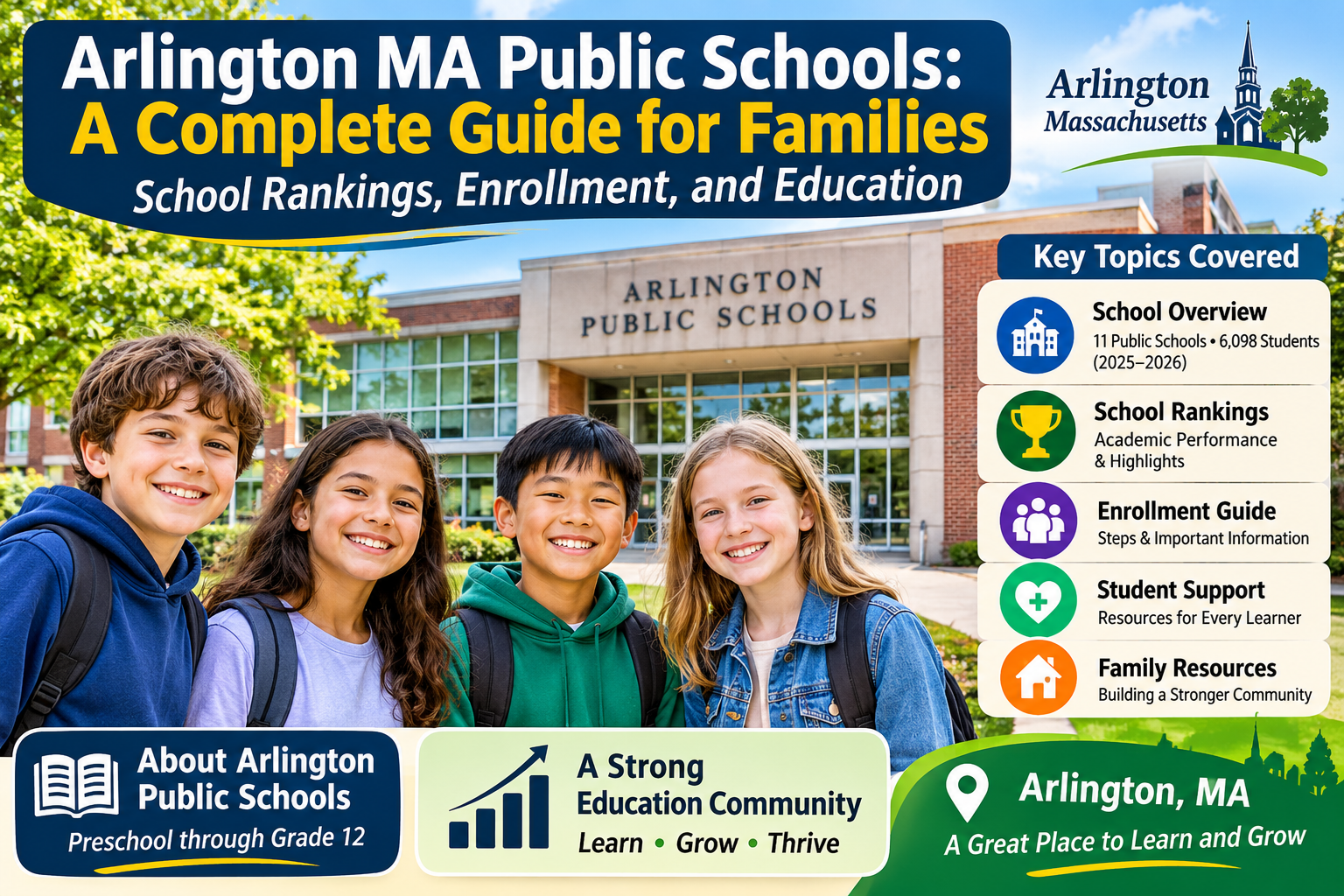
Choosing a community for your family involves more than finding a home in a convenient location. Parents often want to understand the local education system, school options, academic performance, student support services, and resources available to children as they grow. For families exploring Arlington, Massachusetts, the Arlington MA public schools system is an important part of understanding life in the community. Arlington is a town in Middlesex County near Cambridge, Somerville, and the greater Boston area. Its public school district serves students from preschool through high school and includes elementary schools, middle-grade options, and Arlington High School.
According to the Massachusetts Department of Elementary and Secondary Education, Arlington Public Schools served 6,098 students across 11 public schools in the 2025–2026 school year, covering prekindergarten through Grade 12. These figures provide a useful starting point for families researching the district.
Official district information is available through the Arlington Public Schools website, while the Massachusetts Department of Elementary and Secondary Education provides enrollment, assessment, and accountability reports. This guide explains how the district is organized, which schools serve different grade levels, how to research school rankings, and what families should check before enrolling a child. It also explores how schools, family routines, preventive healthcare, and community resources contribute to a child’s overall well-being.

Arlington Public Schools is the public school district serving the town of Arlington, Massachusetts. The district provides educational services across multiple grade levels and supports students with different academic, developmental, and language-learning needs.
The Massachusetts Department of Elementary and Secondary Education lists 11 public schools in the Arlington district for the 2025–2026 school year. The district serves approximately 6,100 students.
The school system includes:
Families should verify current grade configurations, program availability, and enrollment procedures through the district before making decisions. The district’s official profile also provides enrollment by school, student demographics, and other education indicators. Review the Massachusetts DESE Arlington district profile for current published statistics.
A district’s value to a family depends on more than its overall rating. Parents should examine the educational experience their child is likely to receive.
Important considerations include:
Two families may have different priorities. A parent of a kindergartener may focus on early literacy and school transitions, while a parent of a high school student may prioritize advanced courses, career preparation, extracurricular activities, and college planning. The best starting point is to identify the needs of your child and compare schools using consistent, reliable information.

Elementary school is where children build foundational skills in reading, writing, mathematics, problem-solving, communication, and collaboration. Arlington’s elementary schools generally serve kindergarten through Grade 5. The district’s published enrollment records identify the following elementary schools.
Brackett Elementary School is one of Arlington’s elementary schools. When researching Brackett, parents can investigate its current curriculum, student support services, classroom routines, family communication, and opportunities for participation in school activities. Ask about literacy instruction, mathematics learning, enrichment opportunities, and how teachers communicate a child’s progress.
Cyrus E. Dallin Elementary School serves elementary-grade students in Arlington. Families considering the school should review the district’s current school information and ask about classroom learning, student support, arts and enrichment, and transitions between grade levels.
Hardy Elementary School is another option within the Arlington public school system. Parents can research its grade-level curriculum, school-day routines, support services, and communication policies. Visiting an elementary school or attending an available information session can help families understand whether the learning environment suits their child’s needs.
John A. Bishop Elementary School is part of Arlington’s elementary school network. When comparing Bishop with other local schools, consider official performance information alongside practical factors such as the school commute, available services, family engagement opportunities, and the individual needs of your child.
M. Norcross Stratton School serves elementary-grade students. Parents can use the district website and state school profiles to investigate its academic programs, current enrollment, student services, and school policies.
Peirce School is an Arlington elementary school serving students in the primary grades through Grade 5. Families should review the current school directory for program information and confirm any questions about school assignment with the district.
Thompson Elementary School is another elementary option within Arlington Public Schools. Parents may wish to compare its instructional programs, student support resources, communication practices, and daily logistics with those of other schools serving their neighborhood.
A common misconception is that families can automatically select any elementary school in a public district. School assignment policies can depend on residency, attendance boundaries, available space, and district procedures. Do not assume that a nearby school is necessarily your assigned school. Before signing a lease or purchasing a home, contact Arlington Public Schools to confirm the address-specific assignment process. Ask whether boundaries or placement rules are expected to change.
Practical tip: Save the district’s enrollment and school directory pages, and confirm school assignment directly with the district rather than relying solely on a real estate listing or an unofficial school map.

The transition from elementary to middle-grade education introduces new academic and social experiences. Students typically begin managing more complex assignments, interacting with multiple teachers, and developing greater independence. Arlington’s grade structure places Grade 6 at Gibbs School and Grades 7–8 at Ottoson Middle School.
Gibbs School serves sixth-grade students in Arlington. Grade 6 can be an important transition year. Students may encounter changing schedules, new classroom expectations, and increased responsibility for homework and organization.
Families can ask the school about:
Understanding the transition process can help students feel more confident as they move into a new school environment.
Ottoson Middle School serves seventh- and eighth-grade students. During these years, students strengthen their academic skills and begin exploring interests that may shape their high school course choices. Parents researching Ottoson should examine current curriculum information, student support services, extracurricular opportunities, and the district’s official performance reports.
A successful transition begins before the first day of school. Encourage children to practice organizing assignments, maintaining a schedule, preparing school materials, and asking teachers for help when needed. Parents can also discuss friendship changes, online behavior, study routines, and strategies for handling stress. Establishing consistent sleep, nutrition, and physical activity routines can help children manage busy school days. Regular communication with school staff is useful when a student experiences persistent academic, social, or emotional difficulties.

Arlington High School serves students in Grades 9–12 and is a central part of the town’s public education system. High school students begin making more independent decisions about coursework, extracurricular activities, postsecondary plans, and career interests.
Families exploring Arlington High School should consult the current course catalog and official school website for information about academic departments, honors courses, Advanced Placement offerings, electives, and graduation requirements. Course availability and prerequisites can change, so students should review their options with school counselors and teachers.
Parents can help by asking questions such as:
These conversations are more useful than selecting courses based only on a school’s overall rating.
Activities outside the classroom can help students explore interests, develop leadership skills, and build relationships. Depending on current offerings, students may investigate athletics, music, visual arts, theater, clubs, academic organizations, volunteering, and other activities. Check the school’s official activities directory for current schedules, participation requirements, and fees, if any.
High school is an appropriate time to explore different pathways after graduation. Some students may plan to attend a four-year college, while others may consider community college, technical education, apprenticeships, employment, or other training programs. Students can work with counselors to understand graduation requirements, course selection, application timelines, financial aid, and career exploration. Parents should also encourage practical skills such as time management, self-advocacy, budgeting, and responsible use of technology.

School rankings are a common starting point for families comparing education options. However, a ranking is a summary of selected indicators, not a complete description of the experience a child will have at a school.
Third-party education websites may combine test results, graduation rates, teacher information, surveys, and other indicators to produce district grades or rankings. For example, Niche’s published Arlington Public Schools profile has awarded the district an overall A grade and placed it among the higher-ranked Massachusetts districts in its 2027 rankings. Rankings can change as the underlying data and methodology change.
Read the Niche Arlington Public Schools profile to see its published rating categories and comparisons. Do not treat any single ranking as a guarantee of educational outcomes. Different organizations may use different data, weighting methods, and reporting periods.
The Massachusetts Department of Elementary and Secondary Education provides information that families can use to investigate academic achievement and district accountability. The official Arlington district accountability report includes measures related to student achievement, growth, attendance, graduation, and progress toward improvement targets.
When reviewing reports, consider:
The latest available report should be checked before publishing specific statistics because data and accountability classifications change.
A district may perform well overall while individual children have different experiences depending on their interests, learning needs, and circumstances. For example, a student who benefits from language-learning services may prioritize support availability. Another student may need a particular enrichment opportunity or a manageable commute. A thoughtful comparison combines official data, school visits, conversations with educators, and a clear understanding of what matters to your family.

Enrollment is one of the most important practical steps for families moving to Arlington or preparing a child to start school. The exact process depends on the student’s grade, residency, and the district’s current requirements.
Begin with the official Arlington Public Schools website and locate the current registration instructions.
Families should be prepared to check requirements related to:
This list is a planning guide, not a complete official checklist. Use the district’s current instructions to determine which documents are required and how to submit them.
Families planning for kindergarten should confirm the current age eligibility rules, registration deadlines, required documents, and any orientation or screening procedures. Do not rely on an old school-year calendar. Registration dates and processes may change annually. Parents moving into town should contact the district promptly to learn what documentation is needed and how placement is handled when school is already in session.
Families who relocate during the academic year should contact the district to discuss enrollment, school assignment, and the transfer of records. If a child has an individualized education program or receives other specialized services, ask how those records will be reviewed and how continuity of support will be addressed. It is also helpful to ask about transportation, meal arrangements, attendance procedures, and how the child can connect with teachers and classmates.
Before completing registration, confirm:
Getting answers early can reduce delays and help children prepare for the transition.

A school district’s calendar and transportation arrangements influence family routines just as much as its academic programs.
Families should obtain the current school calendar from the official district website. Check the first and last days of school, holidays, professional development days, vacation periods, early dismissals, and any school-specific events. Do not assume that all schools have identical schedules for every event. Review individual school announcements when planning appointments, travel, or childcare.
Transportation eligibility, routes, stops, and schedules depend on district policies and current arrangements. Parents should ask the district whether their child’s school offers transportation for their address, whether registration is necessary, and what rules apply to changes in pickup or drop-off arrangements. Families planning to walk, cycle, or drive should review the school’s arrival and dismissal procedures.
Working parents may need childcare that covers the time before school starts or after dismissal. Ask about district programs, school-based offerings, and independent providers serving the area. Confirm eligibility, fees, availability, operating hours, and holiday coverage. Having a backup plan for unexpected schedule changes can make the school year easier for the entire household.

A strong school comparison considers whether the district can support a child’s individual learning and developmental needs. Arlington’s official state profile includes information on selected student populations, including students with disabilities and English learners.
Families who have questions about special education should contact the district’s appropriate student services team. Parents may wish to ask about evaluation procedures, individualized education programs, accommodations, related services, family participation, and transitions between schools. If a child already receives services in another district, request guidance on how to transfer records and arrange a review of the child’s needs. For authoritative information, consult the district’s official special education resources and applicable Massachusetts education guidance.
Families whose children are developing English proficiency should ask about language assessment, available instructional support, communication with caregivers, and interpretation or translation services. Parents should feel comfortable requesting explanations of school policies and academic progress in a language they understand.
Children may need help adjusting to a new school, managing peer relationships, dealing with academic pressure, or navigating family changes. Ask schools about counseling resources, referral processes, bullying prevention, and how parents can communicate concerns. For urgent or ongoing concerns, follow the school’s established support procedures rather than assuming that a particular service is automatically available at every grade level.

Schools are an important part of a child’s environment, but families also benefit from local libraries, parks, recreation programs, healthcare providers, and community activities.
Public libraries can support reading, homework, research, and independent learning. Families can explore the Robbins Library for information about its collections, programs, events, and available resources. Ask about children’s activities, teen programs, digital resources, and educational events that may complement classroom learning.
Outdoor activities can help children build healthy routines and enjoy time with family and friends. Arlington has parks, playgrounds, and recreational opportunities that families can investigate through town resources. The right option depends on a child’s age, interests, accessibility needs, and activity preferences. Families should confirm current facility information, seasonal schedules, and any registration requirements before visiting a program or facility.
School-age children benefit from regular healthcare, adequate sleep, balanced nutrition, physical activity, and preventive dental care. Tooth decay can interfere with comfort, eating, sleep, and school participation. Establishing regular brushing and flossing habits, choosing water frequently, and arranging routine dental visits can help protect children’s oral health.
For families looking for a local dental provider, Arlington Dental can serve as a resource for information about dental care and preventive visits. Parents can ask their dental team about age-appropriate brushing techniques, cavity prevention, fluoride, and how to help children feel comfortable during appointments. Dental appointments should be scheduled around the family’s needs and the practice’s availability. Families should contact their chosen provider directly to confirm services, insurance, appointment times, and any age-specific policies.
Children often manage school more comfortably when daily routines are predictable.
Families can support them by:
These habits do not replace school-based support, but they can contribute to a more manageable daily routine.

There is no single checklist that identifies the perfect school for every child. The most useful decision process considers academic information alongside individual needs and family logistics.
Start by contacting Arlington Public Schools with your residential address and your child’s grade level. Ask for the correct school assignment and clarify any relevant boundaries or placement policies.
Look at state assessment reports, accountability indicators, enrollment information, and the school’s current published resources. Pay attention to the reporting year and the number of students represented in a particular statistic.
Consider whether your child would benefit from specific academic supports, language services, enrichment, counseling, extracurricular activities, or accessibility accommodations. Write down your questions before speaking with the school.
When available, attend an information session, arrange a visit, or speak with school staff. Ask how teachers communicate with parents, how students receive help, and what happens when a child struggles academically or socially.
Consider travel time, transportation eligibility, childcare, school-day schedules, and family work commitments. A school that fits your child’s needs and your household routine may be a better choice than one selected solely because of a ranking.
District policies, school assignments, programs, and enrollment figures can change. Confirm key details directly with the district before finalizing a move or submitting registration paperwork.
Families often focus on academic rankings while overlooking details that can affect the school experience.
Yes. Residential addresses can determine school assignment under district policies. Verify the assignment directly with Arlington Public Schools before making a housing decision.
Not necessarily. Some programs have specific eligibility criteria, prerequisites, capacity limits, or registration requirements. Ask the district or school for current details.
Reviews can offer useful perspectives, but they represent individual experiences and may not reflect every classroom or student group. Combine reviews with official data and direct conversations with school staff.
Contact the teacher or appropriate school staff to discuss the concern and identify the next steps. Ask how progress will be monitored and which support options may be appropriate.
Check official announcements throughout the year, particularly before enrollment, at the beginning of a new school year, and when a child transitions between grade levels.
The Massachusetts Department of Elementary and Secondary Education lists 11 public schools in Arlington for the 2025–2026 school year. The district serves students from prekindergarten through Grade 12.
Arlington Public Schools receives favorable ratings on some third-party ranking platforms. For a more complete picture, compare these ratings with official Massachusetts assessment and accountability data.
Arlington’s elementary schools include Brackett, Cyrus E. Dallin, Hardy, John A. Bishop, M. Norcross Stratton, Peirce, and Thompson. Confirm the current school directory and grade assignments with the district.
Arlington’s public school grade structure includes Gibbs School for Grade 6 and Ottoson Middle School for Grades 7 and 8.
Arlington High School serves students in Grades 9 through 12. Families should consult the official school website for current academic programs and graduation requirements.
Start with the official district website and follow its current enrollment instructions. Confirm residency documentation, age eligibility, school assignment, required health records, and deadlines.
Contact Arlington Public Schools with your residential address and your child’s grade level. Confirm the assignment directly rather than relying only on third-party maps.
Niche and other school-comparison websites publish rankings and ratings. The Massachusetts DESE website provides official assessment and accountability reports for a more detailed evaluation.
Families should contact the district’s student services or special education department to learn about evaluation procedures, individualized education programs, accommodations, and available services.
Visit the official Arlington Public Schools website and locate the current district calendar. Check individual school announcements for additional dates and schedule changes.
Arlington offers public schools, libraries, parks, community services, and access to the greater Boston area. Whether it suits a particular family depends on housing costs, commute requirements, school needs, and lifestyle preferences.
The official website is arlington.k12.ma.us. It is the best starting point for current school information, enrollment procedures, district announcements, and school contacts.
The district reported 6,098 students for the 2025–2026 school year in the Massachusetts DESE profile. Enrollment changes over time, so consult the latest published figures when making comparisons.
Yes. The district lists Menotomy Preschool among its public schools. Families should contact the district to confirm current eligibility requirements, available programs, registration procedures, and any fees.
Gibbs School serves Grade 6, while Ottoson Middle School serves Grades 7 and 8 under Arlington’s current grade structure. Confirm current school configurations with the district.
The Massachusetts Department of Elementary and Secondary Education publishes district and school profiles, assessment results, enrollment information, and accountability reports.
Do not assume that families can select any school. Assignment and placement depend on district policies, residency, and other applicable requirements. Contact the district to confirm your options.
Confirm enrollment and transportation, obtain school supplies, review schedules, discuss the transition with your child, and contact the school about orientation or support services.
Encourage consistent sleep, nutritious meals, physical activity, good hygiene, and preventive healthcare. Regular dental checkups and daily brushing and flossing can also support children’s oral health.
Families can contact Arlington Dental to ask about available dental services, preventive visits, scheduling, and insurance. Confirm current services and appointment availability directly with the practice.
Choosing a school is an important decision that deserves careful research. Arlington Public Schools provides educational options from preschool through high school, with multiple elementary schools, a dedicated Grade 6 school, Ottoson Middle School, and Arlington High School. Families researching arlington ma public schools should begin with official district resources, verify school assignments, compare current performance data, and investigate the programs and support services that matter most to their children.
Online ratings can help organize an initial search, but the strongest decisions combine reliable statistics, direct communication with school staff, and a clear understanding of a child’s needs. Beyond academics, families can explore Arlington’s libraries, parks, community activities, and local healthcare providers to build a supportive environment for children. Arlington Dental encourages families to include preventive oral health in their children’s overall wellness routines. For questions about dental services or scheduling, contact the practice directly. If you searching for a dentist near Arlington, MA, please visit Arlington Dental, 43 Broadway, Arlington, MA 02474. (781) 641-0500.