43 Broadway, Arlington, MA 02474. Monday–Saturday, 9 a.m.–5 p.m.
Click to Call: (781) 641-0500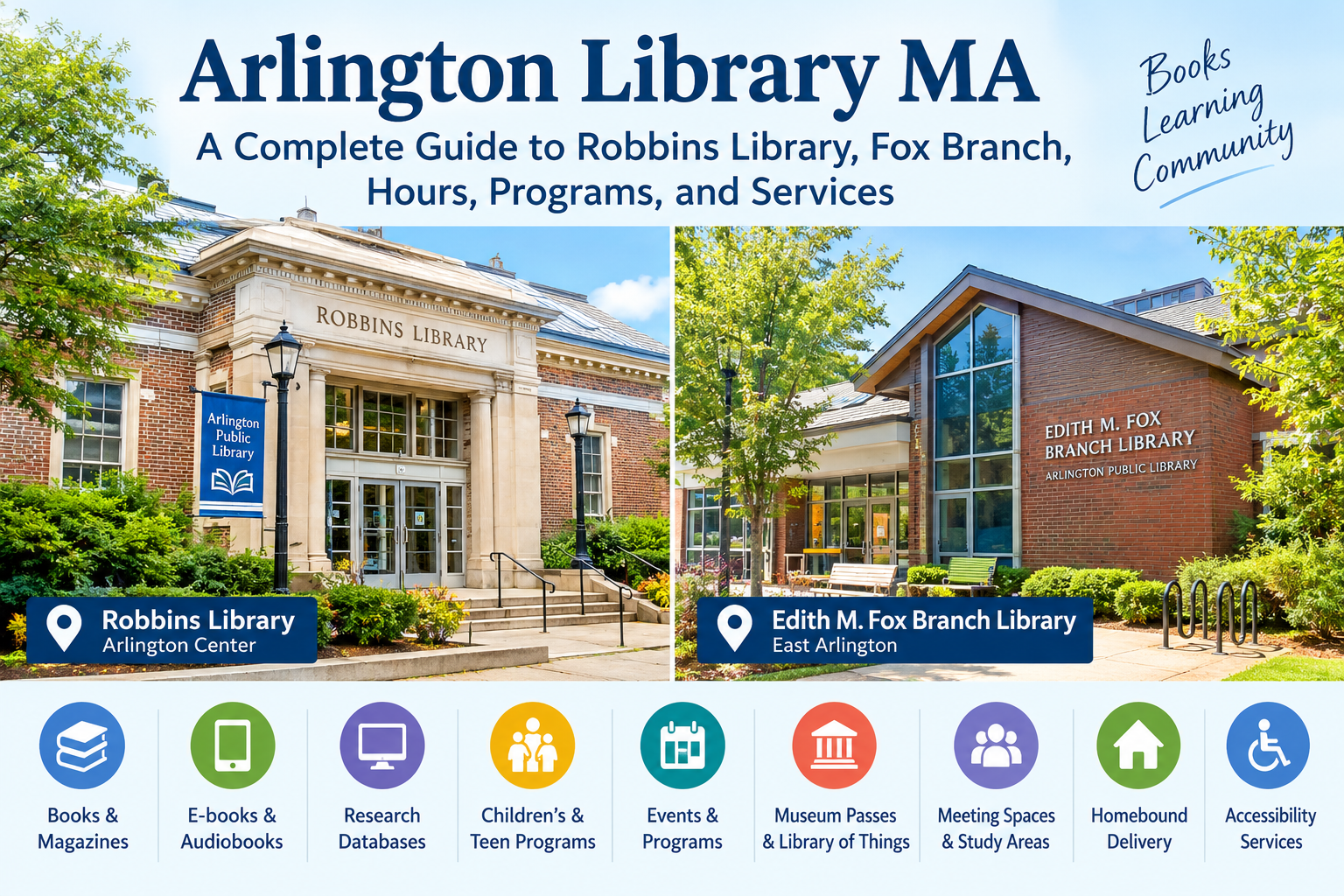
The Arlington Library MA system is an important community resource for residents, students, families, professionals, and visitors. Located in Middlesex County, Arlington has two public library locations: Robbins Library in Arlington Center and the Edith M. Fox Branch Library in East Arlington.
These libraries provide access to books, magazines, newspapers, e-books, audiobooks, research databases, technology, children’s activities, teen programs, community events, and local history collections. They also offer services that many people may not immediately associate with a traditional library, including museum passes, art prints, a Library of Things, meeting spaces, homebound delivery, and digital entertainment.
Whether you are looking for Arlington library MA hours, trying to get a library card, searching the catalog, or planning a family visit, understanding the available services can help you make the most of these community resources.
This guide explores Robbins Library, the Fox Branch, borrowing privileges, online collections, children’s and teen services, study spaces, events, accessibility, and the library’s role in Arlington’s community life.

Arlington’s public library system operates through two locations that serve different parts of town.
Robbins Library is the main public library in Arlington. It is located in Arlington Center at:
Robbins Library
700 Massachusetts Avenue
Arlington, MA 02476
Phone: (781) 316-3200
Website: https://www.robbinslibrary.org/
The main library provides collections and services for children, teenagers, and adults. Its resources include physical books, digital materials, research databases, public computers, printing, meeting spaces, and community programming.
The building is also a notable architectural landmark. Its historic design and central location make it an important part of Arlington Center.
The Edith M. Fox Branch Library serves residents in East Arlington and surrounding neighborhoods.
Fox Branch Library
175 Massachusetts Avenue
Arlington, MA 02474
Phone: (781) 316-3198
The branch provides access to library materials and community services in a smaller neighborhood setting.
Having two locations makes it easier for residents in different parts of Arlington to access public library resources. People should check the official library website for current branch services, programs, hours, and availability.
Arlington is part of the Minuteman Library Network, a cooperative library network serving communities in the region.
This arrangement allows eligible cardholders to access resources beyond their home library. Borrowers can search a shared catalog, request eligible materials from participating libraries, and use borrowing and return services according to network policies.
For residents, this can significantly expand the range of books and other materials available to them.

Robbins Library is one of Arlington’s most recognizable civic buildings. Its location near Town Hall and other Arlington Center destinations makes it easy to include in a visit to the town center.
Robbins Library was built in 1892 with funds donated by Maria C. Robbins in memory of her husband, Eli Robbins.
The building was designed in the style of an Italian Renaissance palace. Its architecture gives the library a distinctive appearance compared with many modern public library buildings.
The front entrance was modeled after the Cancelleria Palace in Rome. Inside, the historic Reading Room features architectural details that contribute to the building’s character, including a fireplace, marble mosaic floor, oak finishes, columns, and decorative ceiling elements.
The building is more than a place to borrow books. It is part of Arlington’s architectural and cultural history.
The library’s location at 700 Massachusetts Avenue places it near several important town destinations.
Visitors can combine a library visit with:
This central location makes Robbins Library a convenient stop for people who live, work, study, or shop in the area.
Before planning a visit, consider what you want to accomplish. Someone returning a book may only need a quick stop, while a student researching a project may need more time to use the collections, computers, or study areas.
Check the library’s website for current opening hours, room availability, event schedules, and any temporary service announcements.

Checking the Arlington library MA hours before visiting is one of the most important planning steps. Robbins Library and Fox Branch have different schedules, and some hours change seasonally.
The following schedule reflects the library’s published hours information. Check the official schedule before traveling because holidays, weather, staffing, and special events may affect access.
The Robbins Library website publishes this general schedule:
| Day | General opening hours |
|---|---|
| Monday | 9 AM to 9 PM |
| Tuesday | 9 AM to 9 PM |
| Wednesday | 9 AM to 9 PM |
| Thursday | 9 AM to 9 PM |
| Friday | 9 AM to 5 PM |
| Saturday | 9 AM to 5 PM |
| Sunday | 2 PM to 5 PM, October through May |
The Children’s Room has a separate schedule:
The Children’s Room closes earlier than the main library on Monday through Thursday. Families planning to visit should take this difference into account.
The Fox Branch has a different schedule:
| Day | General opening hours |
|---|---|
| Monday | Closed |
| Tuesday | 9 AM to 5 PM |
| Wednesday | 12 PM to 8 PM |
| Thursday | 9 AM to 5 PM |
| Friday | 9 AM to 5 PM |
| Saturday | 9 AM to 5 PM, September through June |
| Sunday | Closed |
The branch’s Saturday schedule changes during the summer. Confirm the current schedule before making a special trip.
Both locations observe a number of holidays and may close or operate on adjusted schedules.
Published holiday closures include:
Holiday arrangements may include additional weekend closures. Always check the official hours page for the latest information.
A little preparation can make a library visit more productive.
Official hours: https://www.robbinslibrary.org/about/hours/

A library card provides access to a wide range of resources, including physical books, digital collections, research databases, and other borrowing services.
If you are new to Arlington or have never used the local library system, getting a card is a useful first step.
Eligibility and registration requirements are determined by library and network policies. Residents of Arlington and people eligible through participating Minuteman Library Network communities can generally apply for library privileges.
The library may ask applicants to provide identification and proof of address or other documentation, depending on their circumstances.
For the latest requirements, consult the library’s official library card information rather than relying on an old application form.
A typical registration process involves these steps:
Check whether online registration or temporary digital access is available before visiting.
Depending on eligibility and the applicable service rules, a library card can provide access to:
Some resources have separate borrowing limits or account requirements.
Treat your library card like an account that gives access to personal borrowing information and digital services.
Useful habits include:
The library catalog is one of the most useful tools for finding materials.
Instead of walking through shelves hoping to find a particular title, visitors can search the online catalog before traveling to the library.
The Robbins Library website provides access to the Minuteman Library Network catalog.
You can search by:
For example, a student researching Massachusetts history might search for books about the American Revolution, local history, or New England communities.
A parent looking for children’s reading materials might search by author, reading level, subject, or series.
One benefit of the Minuteman Library Network is access to participating libraries beyond Arlington.
If an item is not available at Robbins Library or Fox Branch, search the network catalog to see whether another participating location has it.
Eligible items may be requested for pickup at an available location, depending on network rules and item restrictions.
Many library materials can be renewed if they meet the library’s renewal conditions.
Renewal availability may depend on:
Review your online account or ask library staff if you are unsure whether a particular item can be renewed.
If a book or other item is currently checked out, you may be able to place a hold through the catalog.
After receiving a notification that an item is ready, follow the pickup instructions and collect it before the hold expires.
This is especially useful for popular titles, new releases, and materials that are not available at your preferred branch.

Public libraries now provide access to many resources online. The digital collections available through Robbins Library help residents read, learn, research, and enjoy entertainment without always visiting the building.
E-books allow readers to access books on compatible digital devices.
Depending on the collection and platform, users may be able to read on:
E-books are useful for people who prefer adjustable text sizes, digital reading, or carrying several books on one device.
Audiobooks provide another way to enjoy books and educational materials.
They can be helpful for people who listen while commuting, walking, exercising, or completing household tasks.
The library provides access to digital audiobook services through its online collections. Availability and borrowing limits depend on the platform and title.
Digital magazines provide access to publications through compatible apps or web services.
Readers can explore different subjects, including lifestyle, science, business, technology, cooking, travel, and current affairs.
The library’s digital services include platforms such as Kanopy and Hoopla, which may offer films, television programs, documentaries, music, and other media.
These services can be useful for people who want access to educational or entertainment content through their library account.
Language-learning resources can support residents who want to practice a new language or improve existing skills.
The library lists Mango Languages among its digital resources. This type of platform can help learners build vocabulary, practice pronunciation, and study at their own pace.
Online newspapers and research databases can help students, professionals, and general readers find reliable information.
Depending on the resource, users may access:
These resources can be particularly valuable for school assignments, personal research, and lifelong learning.
To get started:
If you experience difficulty signing in, contact library staff for assistance.
Children’s services are an important part of the Arlington public library system. Libraries help support early literacy, curiosity, creativity, and learning through books, activities, and educational programs.
Robbins Library has a dedicated Children’s Room, and the library system provides resources for children and families.
Storytime introduces young children to books, songs, rhymes, and storytelling.
These activities can help children:
Parents and caregivers can check the library’s event calendar for age ranges, registration requirements, and current program availability.
Early literacy activities help children develop skills that support future reading and communication.
Parents can encourage early literacy at home by:
A regular library visit can become part of a family’s weekly routine.
The Children’s Room provides reading materials for different ages and interests.
Families can explore:
Parents can ask librarians for suggestions based on a child’s interests, reading development, or school assignments.
The library website lists Children’s Discover It Yourself resources and children’s DIY collections.
These resources can include activities and materials that encourage children to explore science, creativity, problem-solving, and hands-on learning.
Parents should check the program details and availability before visiting.
A successful library visit with young children does not need to be complicated.
The goal is to help children see the library as a welcoming place to discover and learn.

Teenagers can use the library for academic support, reading, research, technology, and social activities.
A library can provide a different environment from home or school, especially for students who need a quiet place to work.
Students may use library materials and technology to complete school assignments.
Useful resources can include:
Students should check current facility rules and room availability before planning group study sessions.
Teen collections help readers explore different genres and subjects.
They may include:
Library staff can help teens find materials that match their interests and reading preferences.
The library’s events calendar may include programs for teenagers, such as game days, creative activities, workshops, and other social or educational events.
These activities give young people opportunities to meet others, explore interests, and use the library beyond traditional studying.
Teens can also use digital resources to develop skills outside the classroom.
Examples include language learning, research, reading, media exploration, and personal-interest projects.
Parents and teens should check individual platform requirements and access policies.
Arlington libraries serve adults with collections, events, research support, and opportunities for social connection.
Whether someone wants to learn a new skill, join a book discussion, research family history, or find a quiet place to read, the library offers several options.
Book groups bring readers together to discuss selected titles.
Participating in a book group can help people:
Check the library’s events calendar for current groups, selected titles, meeting dates, and registration details.
Libraries can help people access technology and digital information.
Visitors may need assistance with:
The exact assistance available can vary, so contact the library if you need help with a specific device or service.
Community language programs can help people practice communication and build confidence.
The library’s event listings may include conversation groups or other language-related activities.
Digital language-learning services can also support independent study.
Libraries can be useful resources for older adults who want to stay informed, socially connected, and engaged in lifelong learning.
Possible areas of interest include:
Ask library staff about available services and accessibility options.

A public library is not only a place to borrow books. Its spaces can support individual study, research, reading, and group activities.
Robbins Library lists room reservations and meeting spaces among its services.
Students and adults may use library spaces for reading, writing, and focused work.
A quiet public environment can be helpful for people who need a break from household distractions.
Before visiting, review the library’s rules about study spaces, seating, food, and device use.
Meeting rooms can provide a location for certain community, educational, or group activities.
Availability may depend on room size, scheduling, intended use, and library policies.
If you are planning a meeting, check the room reservation policy before inviting participants.
The library’s community spaces may host educational programs, workshops, book groups, presentations, and other public events.
Some programs require registration, while others may be open to visitors without advance sign-up.
To reserve a room:
Do not assume that all rooms are available for private events or commercial activities. Check the library’s policy first.
One valuable library service is access to museum passes.
Robbins Library lists museum passes among its resources, providing eligible library users with a way to explore cultural destinations in the Boston area.
Museum passes are library-supported admission benefits that can make visits to participating institutions more affordable.
Depending on the destination, a pass may provide discounted admission, a set number of tickets, or another type of access benefit.
The conditions vary by institution.
The library advertises access to passes for Boston-area museums, zoos, the Aquarium, and the Harbor Islands.
These resources can help families and individuals plan educational outings.
Before planning a trip:
Some destinations may require a separate timed reservation even when you have a library pass.
Museum passes can help residents explore educational and cultural destinations without paying the full standard admission price.
They are especially useful for families planning school-break activities, weekend outings, or visits with relatives.

The Library of Things is an example of how modern libraries have expanded their collections.
Instead of limiting borrowing to traditional reading materials, the service includes selected gadgets, tools, games, and other useful items.
A Library of Things allows eligible borrowers to access nontraditional library materials.
This type of collection can help people try an item, complete a project, or enjoy an activity without purchasing something they may use only occasionally.
Robbins Library also lists children’s Discover It Yourself kits and art prints among its collections.
The service may be useful for:
Nontraditional items may have different rules from ordinary books.
Before borrowing, review:
The catalog or library staff can provide information about specific items.
Robbins Library is an important resource for people researching Arlington’s past.
The Local History Room provides access to historical materials and information about the town and its residents.
Local history collections may help researchers investigate:
The library also provides access to online historical materials through resources such as the Internet Archive and Digital Commonwealth.
People researching family history may use library resources to explore historical records and reference materials.
Research may involve census information, old newspapers, family documents, town records, photographs, and published histories.
Some materials may be available online, while others require an in-person visit.
Historical research can take time, especially when using archival materials.
Before visiting:
The library’s older Local History Room guide describes an independent research card for certain research access. Because access procedures can change, contact the library for current requirements before planning a research visit.
Local history helps residents understand how Arlington developed.
Historical materials can reveal changes in neighborhood streets, businesses, public buildings, transportation, schools, and community life.
For students, historians, homeowners, and family researchers, these resources provide a connection between the present-day town and its past.

Access to technology is another important public library service.
Robbins Library provides printing resources and technology services for visitors who need to work with documents or digital information.
Printing may be useful for:
The library website provides information about sending print jobs from home and using available printing resources.
Check current instructions, fees, file formats, and pickup procedures before sending a document.
Public computers can help people access online services, conduct research, and complete tasks.
People without a computer at home may find public library technology especially useful.
Follow the library’s computer-use policies and avoid entering sensitive information on a public device unless you understand the security risks.
Scanning services can help people convert paper documents into digital files.
This can be useful for school, work, personal records, and research.
Ask staff which equipment is available and whether there are any costs or usage limits.
A community library should serve people with different needs and circumstances.
Robbins Library lists accessibility services and homebound delivery among its services.
People who need accessible collections, services, or spaces should review the library’s accessibility information.
If you have a specific requirement, contact the library before visiting. Staff may be able to explain available accommodations or suggest the most suitable location.
Some residents may be unable to visit the library because of mobility limitations, illness, disability, or other circumstances.
Robbins Library lists a homebound delivery service for people who cannot easily come to the building.
This service can help eligible residents continue accessing reading materials and other library resources.
Contact the library and explain the type of assistance you need.
Ask about:
Confirm the current policy directly with library staff.

The library’s event calendar helps residents discover activities for different age groups and interests.
Programs may include storytimes, book groups, workshops, technology activities, conversation groups, and special events.
The official Robbins Library website includes an events section.
Visitors can review listings to find:
Some activities may take place at Robbins Library, while others may be associated with the Fox Branch.
Children’s events can include storytimes, songs, crafts, educational activities, and seasonal programs.
Families should check age recommendations and registration requirements before attending.
Teen activities may include game days, workshops, reading-related programs, and opportunities to use the library’s social and educational spaces.
Adults can look for book discussions, language groups, presentations, workshops, and other learning opportunities.
Library programs provide opportunities for people to learn new skills and connect with others.
They can also introduce residents to resources they may not otherwise discover, such as digital databases, local history collections, or museum passes.
For people new to Arlington, attending a public library event can be a simple way to become more familiar with the community.
Public libraries depend on municipal support, professional staff, volunteers, community participation, and other sources of assistance.
The Arlington Libraries Impact Report 2025 describes how the town and local support organizations contribute to the library system.
The report states that the Town of Arlington provided approximately 81% of the library budget in FY2025. It also identifies philanthropic and community support organizations that help fund materials, equipment, programs, and operating needs.
Friends organizations support library services through activities such as fundraising, volunteering, and targeted contributions.
Their work can help support collections, programs, and other community resources.
The Fox Branch also benefits from community support, including activities connected with the Fox & Robbin Shop.
Residents can check current information about volunteer opportunities, donations, and fundraising activities.
The Arlington Libraries Foundation supports the library system through fundraising and donations.
Community contributions can help strengthen services and provide resources beyond the regular municipal budget.
People who want to support the library can consider:
Supporting the library helps maintain a community resource that serves people across different ages and backgrounds.

Choosing the right location depends on where you live and what you need.
Not every service or program is necessarily offered at both locations. Confirm availability before traveling.
The public library system can be a valuable partner in education.
Students need access to reliable information, reading materials, technology, and quiet spaces. Families need resources that encourage learning outside school.
Students can use books, digital databases, newspapers, and reference materials for school assignments.
A librarian may help visitors identify useful resources or navigate the catalog.
Children benefit from having access to a broad selection of reading materials.
Regular library visits can help young readers discover new topics, explore different genres, and develop independent reading habits.
Families can use library programs and digital resources to support learning at home.
Examples include:
Libraries can provide educational and recreational options during school vacations.
Families should check the event calendar for special activities, reading programs, and workshops.

A little preparation can make a library visit easier.
Robbins Library is located in a part of Arlington with several nearby civic, cultural, and commercial destinations.
A visit can be part of a broader trip around Arlington Center.
The historic Town Hall is located near the library and is an important municipal landmark.
Visitors interested in local architecture and town history can explore the surrounding area.
Arlington Center has restaurants, cafes, and independent businesses where visitors can stop for a meal or refreshments.
Checking current business hours and menus is recommended before making plans.
The commercial area provides access to neighborhood retailers and professional services.
Visitors can combine a library trip with shopping or errands.
A short walk through Arlington Center can introduce visitors to the town’s historic buildings, local businesses, public spaces, and community atmosphere.
The library’s location makes it a convenient starting point for exploring this part of Arlington.

Libraries support education, information access, and community life. Residents also need access to everyday services, including healthcare and dental care.
People visiting Arlington Center may want to identify nearby healthcare providers for routine appointments and ongoing care.
Regular dental examinations and professional cleanings can help maintain oral health.
A dentist can examine teeth and gums, identify potential concerns, and recommend preventive or restorative treatment based on individual needs.
Common reasons to schedule a dental visit include:
The appropriate treatment depends on a patient’s oral health and professional evaluation.
For residents looking for a dental practice in Arlington, Arlington Dental is located at:
Arlington Dental
43 Broadway
Arlington, MA 02474
Phone: (781) 641-0500
Website: https://arlingtondentalsmile.com/
The practice provides a local option for people seeking dental care in Arlington and nearby communities.
People can visit the website to learn more about available services, office information, and appointment options.
When selecting a dentist, consider:
A consultation can help determine which dental services are appropriate.
A public library is one of the few community spaces designed to serve people across nearly every age group and background.
Robbins Library and Fox Branch provide access to knowledge, technology, cultural resources, and opportunities for social connection.
People use libraries at different stages of life.
A young child may attend storytime, a student may research a school project, an adult may learn a language, and an older resident may explore genealogy.
These activities show how libraries support learning beyond the classroom.
Not everyone has access to books, computers, research databases, or digital subscriptions at home.
Public libraries help reduce these barriers by providing shared resources and assistance.
Events and programs give residents opportunities to meet, learn, and participate in community life.
Book groups, workshops, children’s programs, and cultural activities can help people connect with others who share similar interests.
Local history collections help document the town’s development and preserve information for future generations.
They give researchers and residents an opportunity to understand how Arlington’s neighborhoods, institutions, and community traditions have changed over time.
Library programs, art collections, museum passes, and cultural resources help residents discover creative experiences in Arlington and the wider Boston area.
The Arlington Library MA system provides valuable resources for residents, students, families, and visitors. With Robbins Library in Arlington Center and the Edith M. Fox Branch in East Arlington, the town offers access to books, digital collections, research databases, children’s and teen programs, meeting spaces, museum passes, local history materials, and more.
Whether you want to check library hours, apply for a library card, find a book, attend a community event, or explore Arlington’s history, the library system offers many ways to learn and connect.
Before visiting, check the official Robbins Library website for current hours, holiday closures, events, and service information. Exploring the library’s resources can help you discover more about Arlington and make everyday life in the community more convenient.
For residents looking for local dental care, Arlington Dental is located at 43 Broadway, Arlington, MA 02474. Visit https://arlingtondentalsmile.com/ or call (781) 641-0500 to learn more about the practice and its services.
Robbins Library is the main public library in Arlington, Massachusetts. It is located at 700 Massachusetts Avenue, Arlington, MA 02476. The library offers books, digital resources, children’s and teen services, research assistance, events, and other community resources.
Robbins Library generally opens Monday through Thursday from 9 AM to 9 PM and Friday and Saturday from 9 AM to 5 PM. Sunday hours are generally 2 PM to 5 PM from October through May. Check the official hours page for holidays and schedule changes.
Yes. Arlington has two public library locations: Robbins Library at 700 Massachusetts Avenue and the Edith M. Fox Branch Library at 175 Massachusetts Avenue in East Arlington.
Visit Robbins Library or Fox Branch and ask about registration. The library may require identification and proof of address or other information. Check the official website for current eligibility and application requirements.
Arlington participates in the Minuteman Library Network. Eligible cardholders can search the shared catalog and request many available materials from participating libraries, subject to borrowing rules and item restrictions.
Yes. Robbins Library provides access to digital collections that include e-books and audiobooks through online services. Access generally requires a valid library account and is subject to each platform’s borrowing rules.
Yes. The library offers children’s resources and programs that may include storytimes, educational activities, reading collections, and hands-on learning opportunities. Check the event calendar for current schedules and age recommendations.
Robbins Library lists room reservations among its services. Availability, eligibility, and reservation rules depend on the room and intended use. Review the official room reservation information before planning a meeting or study session.
Yes. Robbins Library provides access to museum passes for selected Boston-area museums, zoos, the Aquarium, and Harbor Islands. Pass availability, reservation requirements, and admission conditions vary by destination.
Visit the events section of the official Robbins Library website at https://www.robbinslibrary.org/. It lists activities and programs for children, teens, and adults, including dates, locations, and registration details.
Robbins Library is located at 700 Massachusetts Avenue, Arlington, MA 02476. Its main phone number is (781) 316-3200.
The Edith M. Fox Branch Library is located at 175 Massachusetts Avenue, Arlington, MA 02474. Its phone number is (781) 316-3198.
Robbins Library generally offers Sunday hours from 2 PM to 5 PM during October through May. Sunday service is seasonal, so check the current schedule before visiting.
No. The published Fox Branch schedule lists Monday as a closed day. Check the official website for any temporary schedule changes.
Yes. The Robbins Library website provides access to the Minuteman Library Network catalog, where users can search for books and other materials.
Robbins Library provides technology and printing resources. Check its website for current equipment, printing instructions, costs, and usage policies.
Yes. Eligible cardholders can use many digital services remotely, including e-books, audiobooks, digital magazines, streaming media, language-learning tools, and research databases.
Yes. Robbins Library has a Local History Room and online historical resources relating to Arlington. Some research materials may have special access procedures, so contact the library before planning a research visit.
Robbins Library lists a homebound delivery service for people who cannot easily visit the library. Contact the library to ask about eligibility, available materials, and delivery arrangements.
The official library website is https://www.robbinslibrary.org/. It provides information about both locations, hours, collections, library cards, digital resources, events, and services.