
43 Broadway, Arlington, MA 02474. Monday–Saturday, 9 a.m.–5 p.m.
Click to Call: (781) 641-0500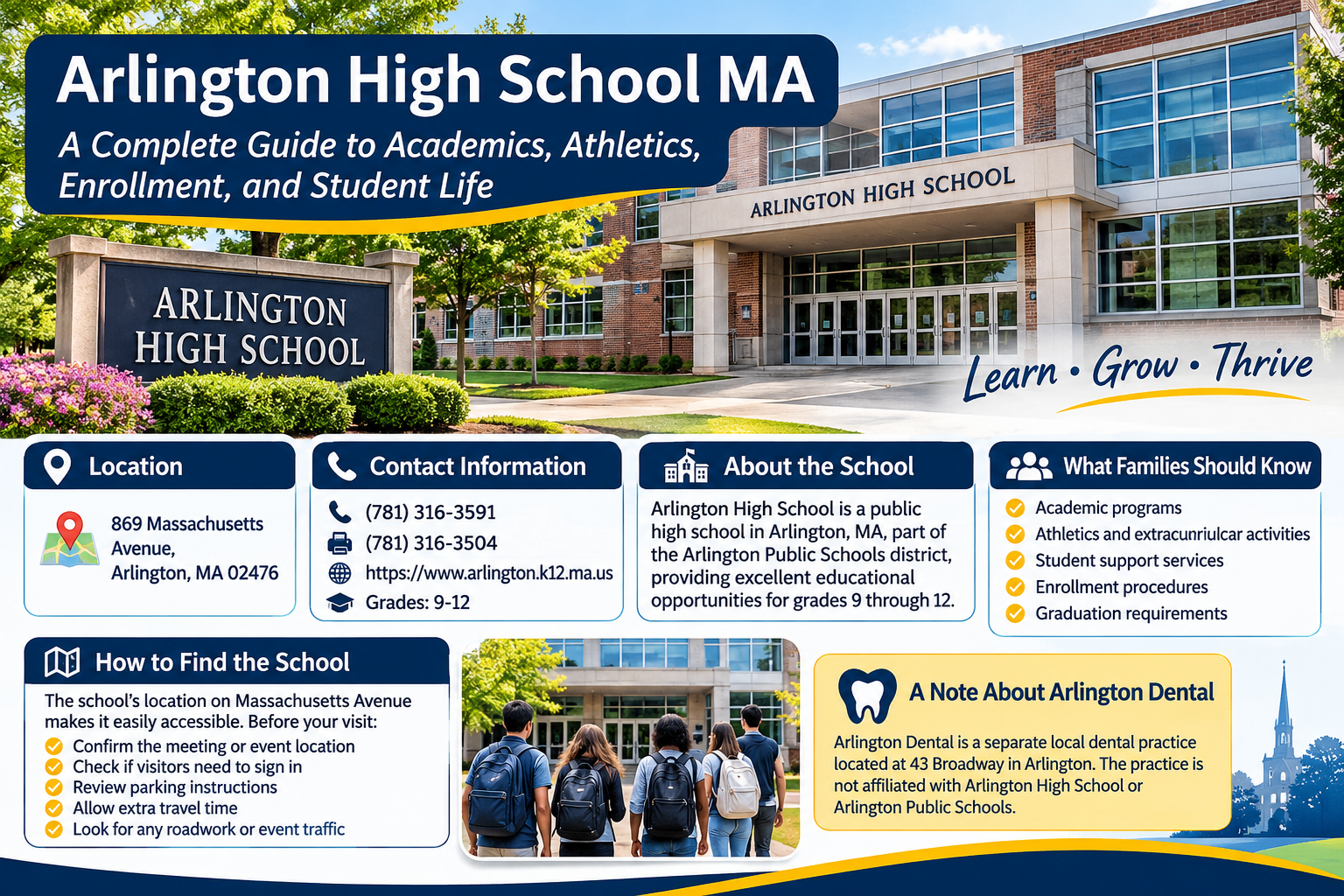
Arlington High School is a public high school located in Arlington, Massachusetts. Serving students in grades 9 through 12, the school is part of Arlington Public Schools and provides educational opportunities for teenagers preparing for college, careers, and life beyond graduation.
For families researching Arlington High School MA, important considerations often include the school’s location, academic programs, student support services, extracurricular activities, athletics, enrollment procedures, and graduation requirements. Students may also want information about the school calendar, daily schedules, course selection, clubs, and other opportunities available during high school.
Arlington High School is an important part of the local community. Its students, educators, families, and staff contribute to the town’s educational and cultural environment. The school is also connected to a wider network of community services, local businesses, libraries, recreational facilities, and healthcare providers.
This guide brings together useful information about Arlington High School in Arlington, Massachusetts. It explains what families should know before contacting the school, how to find official information, and how students can make the most of their high school experience.
The article also introduces Arlington Dental, a separate local dental practice located at 43 Broadway in Arlington. The practice is not affiliated with Arlington High School or Arlington Public Schools.
Arlington High School is located at 869 Massachusetts Avenue, Arlington, MA 02476.
The school serves students from Arlington and operates as part of the Arlington Public Schools district.
Families looking for the school’s address or contact details can use the following information:
Arlington High School
The Massachusetts Department of Elementary and Secondary Education lists Matthew Janger as the principal in its school profile. School leadership and contact information can change, so families should confirm current details through the official school website.
The school’s location on Massachusetts Avenue makes it accessible from different parts of Arlington and neighboring communities.
Families visiting for a meeting, school event, athletic activity, or student appointment should check the school’s directions and visitor instructions before arriving.
Useful planning steps include:
Visitors should follow school security procedures and use designated entrances.

Arlington High School is a public secondary school serving grades 9 through 12.
It is part of Arlington Public Schools, the municipal school district responsible for public education in Arlington, Massachusetts.
The school provides a structured academic environment where students study core subjects, explore electives, participate in activities, and prepare for their next steps after graduation.
The Massachusetts Department of Elementary and Secondary Education reported an enrollment of 1,757 students for the 2025-2026 school year.
The same state profile lists a student-teacher ratio of approximately 13.6 to 1.
These figures provide a useful snapshot of the school, but enrollment and staffing can change from year to year. Families should check the latest state profile for updated information.
Arlington High School serves students in:
Each grade represents a different stage of high school development.
Freshmen adjust to the expectations of high school, while sophomores and juniors continue building academic skills and exploring future options. Seniors typically focus on graduation requirements, college applications, employment opportunities, and postsecondary planning.
Arlington High School is part of a wider educational system.
Arlington Public Schools provides district-level resources, policies, calendars, family information, and educational support.
Families should use the district website for official information about registration, school policies, transportation, calendars, and district announcements.

Academics are central to the high school experience.
Students study subjects designed to develop reading, writing, mathematics, scientific understanding, historical knowledge, communication, and critical thinking.
High school education also allows students to explore interests and prepare for different educational and career pathways.
A typical high school curriculum includes several major subject areas.
English courses help students strengthen reading comprehension, writing, communication, research, and analytical thinking.
Students may study literature, informational texts, composition, grammar, and public speaking.
These skills are useful for college-level study, professional communication, and everyday decision-making.
Mathematics courses develop logical reasoning and problem-solving abilities.
Depending on course placement and graduation requirements, students may study subjects such as algebra, geometry, statistics, and advanced mathematics.
Students should review the current course catalog to understand prerequisites and available options.
Science education helps students understand the natural world through observation, investigation, experimentation, and evidence-based reasoning.
Common high school science disciplines include biology, chemistry, physics, and environmental science.
Laboratory activities can help students apply classroom concepts to practical questions.
History and social studies courses help students understand government, economics, geography, historical events, and social institutions.
These subjects encourage students to evaluate information, consider different perspectives, and understand how communities and societies change over time.
Language courses can help students develop communication skills and learn about different cultures.
Students may have opportunities to study languages offered through the school’s current curriculum.
Families should consult the course catalog for available languages, placement requirements, and graduation expectations.
Electives allow students to explore interests beyond required academic subjects.
Depending on the current program, elective opportunities may include arts, technology, business-related topics, music, practical subjects, and additional academic disciplines.
Students should consider their interests, future goals, graduation requirements, and workload when selecting electives.
Advanced coursework can provide students with additional academic challenges.
Arlington High School’s Massachusetts state accountability data reports that 89.1% of students completed advanced coursework in 2026, compared with 86.7% in 2025.
This indicator provides useful context about participation in advanced academic opportunities. It should not be interpreted as a guarantee that every student has access to the same courses or experiences.
Students interested in advanced classes should speak with school counselors and teachers about eligibility, prerequisites, workload, and academic preparation.

Choosing courses is an important part of high school planning.
The course catalog helps students and families understand available subjects, academic expectations, course descriptions, and prerequisites.
Arlington High School provides a course catalog through its student and parent resources.
A course catalog can help students:
Students should not select courses based only on their titles. Reviewing the course description and expected workload can help them make informed decisions.
Course planning should develop gradually as students move through high school.
Grade 9: Focus on adjusting to high school, meeting foundational requirements, and exploring interests.
Grade 10: Continue core academic subjects and begin considering possible academic pathways.
Grade 11: Review graduation progress, consider advanced courses, and begin planning for college or employment.
Grade 12: Complete remaining graduation requirements and prepare for life after high school.
School counselors can help students understand course options and make academic plans.
Students should ask for guidance if they are uncertain about prerequisites, graduation requirements, schedule conflicts, or the balance between academic and extracurricular commitments.
Families should consult official school resources for the latest course-selection procedures and deadlines.

Graduation requirements help students understand what they must complete before receiving a high school diploma.
Students should review the current Arlington High School graduation requirements rather than relying on information from older handbooks or unrelated school districts.
Graduation requirements generally include successful completion of required coursework and other district or state expectations.
Students should confirm:
The exact requirements should be checked in the current AHS handbook and official district materials.
Keeping track of graduation requirements can help students avoid last-minute problems.
A student who understands their progress can identify missing courses, discuss schedule changes, and plan remaining semesters more effectively.
Families can help by reviewing academic progress with students and attending school meetings when appropriate.
Graduation is an important milestone, but students also need to consider what comes next.
Possible pathways include:
Students should explore their options early enough to understand application requirements, costs, deadlines, and preparation.

The school calendar helps families plan the academic year.
It typically includes the first and last days of school, holidays, professional development days, vacations, early releases, and other important dates.
Families should use the official Arlington Public Schools calendar rather than relying on third-party calendar listings.
The district website provides calendar information and links to school-specific events.
The Arlington High School student and parent page also includes calendar resources.
Families can visit:
Before each school year, review:
School schedules may change because of weather, emergency closures, district decisions, or other circumstances.
Families should check official announcements regularly, especially during winter weather.
For important appointments, transportation arrangements, or family travel, it is helpful to review the calendar in advance.
Knowing the school schedule helps students and families organize their daily routines.
School hours can influence transportation, breakfast arrangements, after-school activities, appointments, and family schedules.
The district’s published calendar and school-hours page provides schedule information. However, families should confirm the current year’s high school hours directly with Arlington Public Schools because schedules may change.
To find the latest school hours:
Students can make school mornings easier by preparing the night before.
Useful habits include:
A consistent routine can help students arrive prepared and reduce unnecessary morning stress.

Families moving to Arlington or preparing for a student’s transition into high school may need information about enrollment and registration.
Arlington High School is part of Arlington Public Schools, so enrollment procedures are managed through the district.
Families may need to contact the district when:
Registration requirements can vary according to the student’s circumstances and district policies.
Families may be asked to provide documents such as:
This is a general preparation list, not a complete official checklist. The district should provide the current requirements.
Before beginning registration, families should:
Families should avoid sending sensitive student information through unofficial websites or unverified email addresses.
Moving from middle school to high school is a major transition.
Students may need to adjust to a larger building, more complex schedules, new academic expectations, and greater personal responsibility.
Families can help by discussing organization, time management, communication with teachers, and how to ask for help.
High school is about more than academic classes.
Students also develop social skills, independence, teamwork, creativity, and confidence through activities and relationships.
A positive school experience can involve classroom learning, clubs, sports, performances, volunteering, and community participation.
Students meet peers with different interests, backgrounds, and experiences.
Developing positive friendships can help students feel connected to their school community.
Students can build relationships by participating in activities, working on group projects, attending school events, and treating others with respect.
High school encourages students to take more responsibility for their learning.
Students often need to manage assignments, meet deadlines, organize materials, and communicate with teachers.
These habits can prepare them for college, work, and other adult responsibilities.
A busy schedule can make it difficult to balance homework, extracurricular activities, family responsibilities, and rest.
Students can benefit from:
Balance is important for long-term academic progress and well-being.

Athletics can be an important part of the high school experience.
School sports provide opportunities for physical activity, teamwork, leadership, discipline, and school spirit.
Students interested in joining a team should review the current athletic department information for sports offered, eligibility requirements, schedules, and registration procedures.
Participating in sports can help students develop:
Teamwork: Athletes learn how to cooperate, communicate, and work toward shared goals.
Time management: Students must balance practices, competitions, classes, and homework.
Discipline: Training encourages consistency and personal responsibility.
Resilience: Sports can teach students how to respond to challenges and setbacks.
Physical fitness: Regular activity supports cardiovascular health, strength, coordination, and overall fitness.
Students should confirm the school’s current athletic eligibility rules before joining a team.
Requirements may involve academic standing, registration, health documentation, physical examinations, and participation rules.
The official athletic department should be used for current information.
Families and community members can support student athletes by attending games, respecting coaches and officials, and encouraging good sportsmanship.
School sporting events can also bring together students, families, alumni, and residents.
Extracurricular activities allow students to explore interests beyond the classroom.
They can provide opportunities to develop new skills, meet people, and contribute to the school community.
Academic clubs can encourage students to explore particular subjects and develop specialized knowledge.
Activities may include discussions, competitions, projects, research, or collaborative learning.
Students should check the current school activity directory for available clubs.
Creative activities can help students express ideas and develop artistic skills.
Depending on current offerings, opportunities may include music, theater, visual arts, writing, and other creative programs.
Arts participation can also build confidence and collaboration.
Leadership organizations and service activities help students learn how to organize projects, communicate with others, and contribute to their community.
Volunteering can provide valuable experience while helping students understand local needs.
Students should consider:
It is often more rewarding to participate consistently in a manageable number of activities than to join too many organizations at once.
Students may face academic, social, emotional, or personal challenges during high school.
Access to appropriate support can help them navigate these situations.
Families should review the current student handbook and official school resources to understand available services and how to request assistance.
School counselors can help students with academic planning, course selection, graduation progress, and postsecondary preparation.
Students may also contact counselors when they need guidance about school-related challenges.
Students who struggle with a subject should speak with their teachers and ask what support is available.
Possible resources may include extra help, academic guidance, tutoring opportunities, or other school-based services.
Families should confirm the current support options with the school.
High school students may experience stress related to academic expectations, friendships, family circumstances, or future planning.
Students should know how to contact appropriate school staff when they need help.
Families should use official school communication channels to ask about available resources and referral procedures.
Students with disabilities may be eligible for educational services and accommodations under applicable laws and district procedures.
Families should contact the appropriate school staff to discuss evaluation, eligibility, educational planning, and available support.
Students who are learning English may need language development support and assistance accessing the curriculum.
Families should contact the district to learn about available services, assessment procedures, and communication resources.

The student handbook is an important resource for understanding school expectations.
It provides information about policies, attendance, behavior, academic responsibilities, technology, and other aspects of student life.
Arlington Public Schools provides a 2026-2027 AHS Student Handbook through its official website.
A high school handbook may address:
Families should read the current handbook rather than relying on older versions.
Knowing school policies helps students make informed decisions and understand their responsibilities.
It can also prevent misunderstandings about attendance, classroom behavior, technology, or other school expectations.
Visit the Arlington Public Schools handbook page:
https://www.arlington.k12.ma.us/apps/pages/index.jsp?pREC_ID=2327433&type=d&uREC_ID=2858178
The district provides links to current handbooks and translated versions for certain languages.

Families often research graduation rates and school performance when comparing educational options.
State education reports provide information that can help families understand academic outcomes and areas of progress.
However, school performance should not be judged using a single statistic.
According to Massachusetts Department of Elementary and Secondary Education accountability data, Arlington High School’s four-year cohort graduation rate increased from 96.4% in 2024 to 98.2% in 2025.
The 2025 rate exceeded the state’s reported target of 95.0%.
This is a useful measure of how many students in a particular cohort completed high school within four years.
It does not describe every student’s experience or guarantee an individual student’s outcome.
The 2026 state accountability report lists an advanced coursework completion rate of 89.1%, up from 86.7% in 2025.
This measure offers insight into student participation in advanced academic opportunities.
Families should also consider course availability, individual student interests, academic support, and the experience of students across different groups.
When evaluating Arlington High School, families may want to review:
State accountability data provides useful context, but it should be considered alongside direct conversations with the school and a review of current educational programs.

Communication between families and schools helps students receive consistent support.
Arlington Public Schools provides official websites and resources where families can find updates.
The school and district websites should be the first places to look for information about:
Families should regularly review official messages from the school and district.
These may include announcements about schedule changes, important deadlines, events, weather closures, and student services.
Parent meetings, school information sessions, performances, athletic events, and other activities can help families stay connected.
These events may also provide opportunities to ask questions and learn more about school programs.
For questions about a particular topic, contact the relevant school or district office.
For example, enrollment questions should go to the district registration office, while course selection questions may be better directed to a counselor or academic department.
Using the correct contact channel can help families receive accurate information more efficiently.
Transportation is an important consideration for students and families.
The most suitable option depends on the student’s address, district transportation policies, available public transportation, walking routes, and family arrangements.
Families who drive students should review school traffic and drop-off procedures.
Traffic can be heavier during morning arrival and afternoon dismissal.
Drivers should follow posted signs, avoid blocking nearby driveways, and use designated areas.
Arlington is served by MBTA bus routes that connect different parts of town with nearby transit stations and communities.
Students and families should check current MBTA routes and schedules to see which options are appropriate for their journey.
Schedules can change, so use the official MBTA website for current information.
Some students may live close enough to walk or cycle to school.
Families should consider route safety, road crossings, visibility, weather, and available bicycle facilities.
Students who cycle should wear appropriate safety equipment and follow traffic laws.
Massachusetts weather can affect travel throughout the school year.
Winter conditions may create snow, ice, reduced visibility, and delays.
During warmer months, students walking or cycling should stay hydrated and use suitable sun protection.
Families should check official school announcements during severe weather.

Arlington High School is part of a larger community with residential neighborhoods, local businesses, cultural attractions, parks, and public services.
Understanding the surrounding area can help families new to Arlington become familiar with the town.
Arlington Center is one of the town’s main commercial and community areas.
It offers restaurants, retail businesses, public services, cultural attractions, and local gathering places.
Residents can explore the neighborhood for dining, shopping, and community activities.
East Arlington is known for its business districts, cultural attractions, and access to Spy Pond and the Minuteman Bikeway.
The area has restaurants, independent shops, and recreational opportunities.
Arlington Heights is a neighborhood in the western part of town.
It includes residential areas and local businesses, offering another place for families to explore community services and shopping.
Arlington has outdoor spaces that support recreation and family activities.
Popular local destinations include:
Families should check town information for park rules, facilities, accessibility, and seasonal programs.
Robbins Library provides educational and community resources.
Libraries can support students with reading materials, research resources, technology access, and educational programs.
Families can check the library’s official website for opening hours and events.
Families in Arlington may need access to healthcare services throughout the year.
Healthcare needs can include routine medical appointments, dental examinations, preventive care, and treatment for specific concerns.
Local providers can help residents manage appointments without always traveling outside the community.
Dental health is an important part of overall well-being.
Students use their teeth every day for eating, speaking, and maintaining a healthy smile. Regular dental care can help identify problems before they become more complicated.
Preventive dental visits may include an examination, professional cleaning, and recommendations for home care.
Teenagers may experience several oral health concerns, including:
Cavities: Tooth decay can develop when plaque bacteria produce acids that damage enamel.
Gum inflammation: Plaque accumulation near the gumline can contribute to gingivitis.
Sports-related dental injuries: Contact sports and recreational activities can expose teeth to injury.
Orthodontic concerns: Some teenagers may benefit from an orthodontic evaluation.
Wisdom teeth: Some young adults develop wisdom teeth that require monitoring or treatment.
Students should speak with a dental professional if they experience tooth pain, swelling, bleeding gums, or dental injuries.
Students participating in sports should consider whether a properly fitted mouthguard is appropriate.
Mouthguards can help protect teeth and oral tissues during certain activities.
A dentist can explain the differences between stock, boil-and-bite, and custom-fitted options.
For students who participate in contact sports, asking about dental protection before the season begins can be a useful preventive step.

Arlington Dental is a separate local dental practice serving patients in Arlington, Massachusetts.
The practice is located at 43 Broadway and provides a local option for individuals and families seeking dental care.
It is not affiliated with Arlington High School, Arlington Public Schools, or the school district.
Arlington Dental
43 Broadway
Arlington, MA 02474
Phone: (781) 641-0500
Website: https://arlingtondentalsmile.com/
Online appointment booking: https://bit.ly/ArlingtonDentalBookOnline
Patients should contact the practice directly to confirm current services, appointment availability, insurance participation, and treatment information.
When choosing a dental provider, families can consider:
Students and parents often balance school, work, extracurricular activities, and family responsibilities.
Planning dental appointments ahead of time can make preventive care easier to maintain.
Families can ask the dental office about available appointment times and scheduling options.

Parents and guardians can support students by helping them develop habits that encourage academic progress, independence, and well-being.
Keep track of important dates, vacations, early releases, examinations, and school events.
A shared digital calendar can help families coordinate schedules.
Students can use planners, calendars, or task-management tools to track assignments and deadlines.
Breaking larger projects into smaller steps can make work easier to manage.
If a student is having difficulty with a subject or school-related issue, encourage them to communicate with the appropriate teacher or counselor.
Early communication can help identify useful support.
Teenagers need sufficient sleep to support learning, attention, and daily functioning.
Consistent bedtime routines and reasonable limits on late-night screen use may help.
Clubs, sports, arts, and community activities can help students explore interests and develop new skills.
Encourage students to choose activities they genuinely enjoy.
Routine healthcare and dental visits can help students stay healthy throughout the school year.
Families should plan preventive appointments rather than waiting until a problem becomes urgent.
Students do not need to have every future decision finalized early in high school.
However, conversations about college, technical education, employment, and other pathways can help them explore possibilities.
Families comparing schools or preparing for enrollment may benefit from asking specific questions.
Asking these questions can help families understand the school and identify the official resources they need.
Families preparing for a student’s first year at Arlington High School can use the following checklist.
Before the school year:
During the school year:
Before the next school year:
This preparation can help families stay organized and make the transition into high school smoother.
Arlington High School is an important educational institution in Arlington, Massachusetts. Serving grades 9 through 12, it provides students with academic instruction, advanced coursework opportunities, extracurricular experiences, and preparation for life after graduation.
Families researching Arlington High School MA should use the official school and district websites for current details about enrollment, course catalogs, calendars, school hours, athletics, student handbooks, and support services.
State education data can also help families understand school performance. The reported 2025 four-year graduation rate of 98.2% and 2026 advanced coursework completion rate of 89.1% offer useful context, although no single statistic describes the complete student experience.
Arlington High School is part of a wider community that includes local businesses, parks, libraries, cultural institutions, and healthcare providers. Arlington Dental, located at 43 Broadway, is one local dental practice serving the community independently of the school system.
For parents, students, and prospective residents, learning about both the school and its surrounding community can make it easier to understand what Arlington has to offer.
Arlington High School is located at 869 Mass Avenue, Arlington, MA 02476. It is part of Arlington Public Schools and serves students in grades 9 through 12.
Arlington High School serves grades 9, 10, 11, and 12. It is a public high school in the Arlington Public Schools district.
The Massachusetts Department of Elementary and Secondary Education lists the school’s main phone number as (781) 316-3591. Families should check the official school website for current contact information.
The Massachusetts Department of Elementary and Secondary Education’s school profile lists Matthew Janger as principal. Families should confirm current leadership information with the school.
The Massachusetts Department of Elementary and Secondary Education reported 1,757 students enrolled for the 2025-2026 school year.
The Massachusetts state accountability report lists a four-year cohort graduation rate of 98.2% for 2025, compared with 96.4% in 2024.
Families can find calendar information through the Arlington Public Schools website and the Arlington High School student and parent resources page. Always check official sources for the latest dates and schedule changes.
Enrollment is managed through Arlington Public Schools. Families should contact the district registration office to confirm residency requirements, documents, grade placement, and registration procedures.
Students can explore athletic teams, clubs, and other extracurricular opportunities. Current offerings, schedules, eligibility rules, and participation requirements should be confirmed through the school’s official resources.
The current handbook is available through the Arlington Public Schools website. The district provides links to the 2026-2027 AHS Student Handbook and other school handbooks.
Yes. Arlington High School is a public high school within Arlington Public Schools in Arlington, Massachusetts.
The school is located at 869 Mass Avenue, Arlington, MA 02476.
The listed main phone number is (781) 316-3591. Confirm current contact information on the official school website.
The Massachusetts Department of Elementary and Secondary Education reported a student-teacher ratio of approximately 13.6 to 1 for the 2025-2026 school year.
The state profile lists 1,757 students for the 2025-2026 school year. Enrollment may change annually.
The course catalog is linked through the school’s current student and parent resources page. Students should consult the latest version when planning their schedules.
Check the Arlington Public Schools calendars and school-hours page for the current academic year’s schedule, including early-release information.
The handbook is available through the Arlington Public Schools handbook page. Families should use the current school-year version.
The Massachusetts state accountability report lists the 2025 four-year cohort graduation rate at 98.2%.
No. Arlington Dental is an independent dental practice located at 43 Broadway, Arlington, MA 02474. It is not affiliated with Arlington High School or Arlington Public Schools.