
43 Broadway, Arlington, MA 02474. Monday–Saturday, 9 a.m.–5 p.m.
Click to Call: (781) 641-0500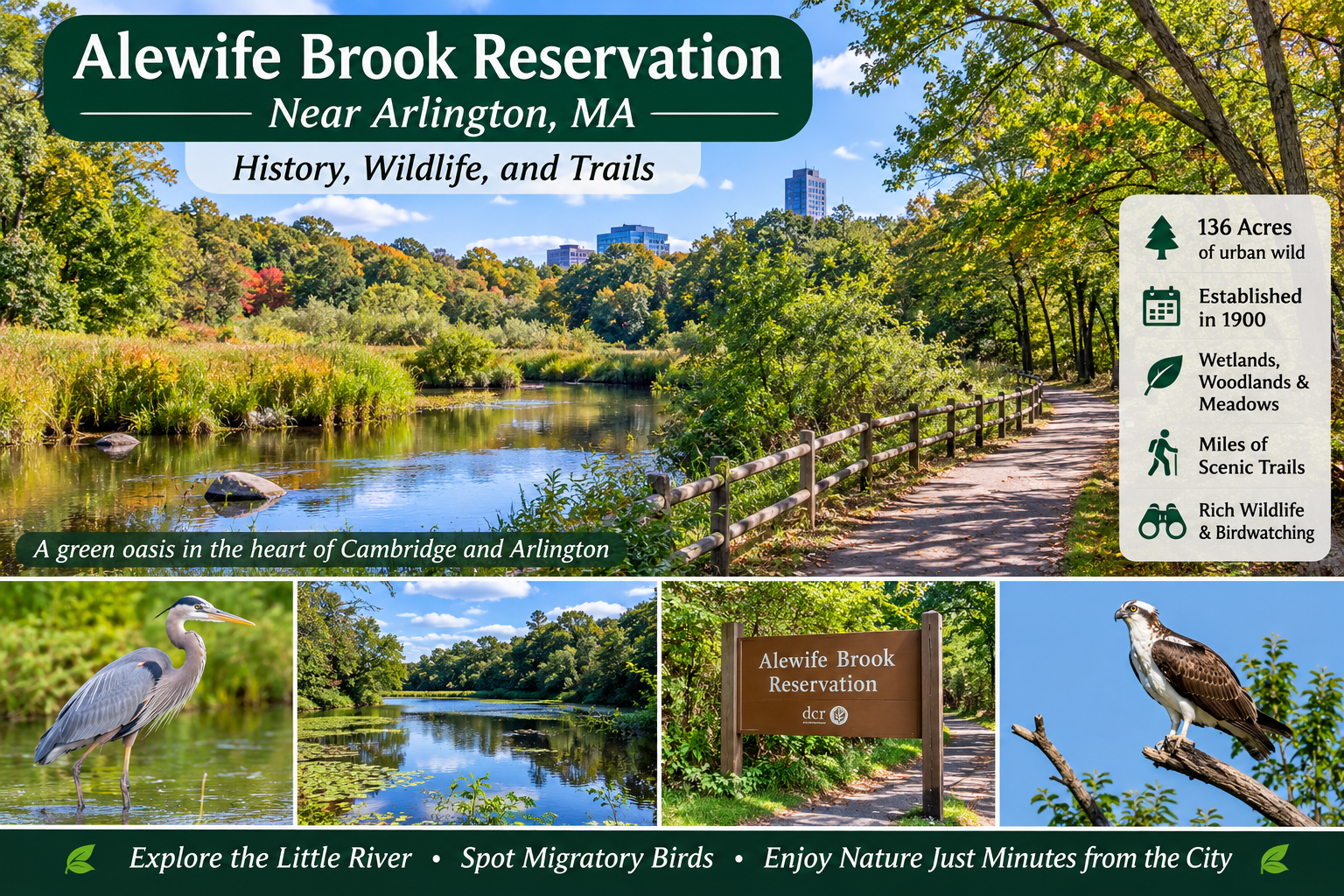
Alewife Brook Reservation is a scenic 136-acre state park and urban wild located along the Alewife Brook in Cambridge, Arlington, and Somerville, Massachusetts. Established in 1900 as part of Greater Boston’s metropolitan park system, the reservation protects a mix of wetlands, woodlands, and meadows in the heart of the city. Visitors today enjoy miles of trails, birdwatching opportunities, and glimpses of history in this green oasis. For Arlington and Cambridge residents alike, the Alewife Brook Reservation offers a peaceful escape into nature just minutes from urban areas.
Little River flows through Alewife Brook Reservation, creating lush wetlands and habitat for wildlife.
The Little River and several ponds (Little Pond, Perch Pond, Blair Pond) wind through the reservation, providing spring spawning grounds for river herring and rich habitat for fish and wetland creatures. In fact, each spring Atlantic herring migrate up Alewife Brook to spawn in these ponds. The reservation is a magnet for wildlife: osprey, great blue herons, ducks, woodcocks, and many other migratory and indigenous birds are common sights. Birdwatchers flock here, especially during spring and fall migrations, to spot egrets, warblers, and even falcons among the trees and marshes. As the Spring-fed Little River flows north into the Mystic River, it carves out a park-like corridor along Alewife Parkway, with natural pockets like a riverside overlook at Jerry’s Pond (just outside the reservation) and boardwalks where one can stroll or watch birds.

The land that is now Alewife Brook Reservation was once part of the Great Swamp and rich floodplain forests of 17th-century Cambridge and Menotomy (now Arlington). Early settlers built mills and drained the wetlands, but much of the area remained marshy. In the early 1900s, landscape architect Charles Eliot (and later Olmsted Brothers) designed the Alewife Parkway and Reservation as part of Boston’s Metropolitan Park District, a vision of green spaces connecting the city. Alewife Brook was straightened and channelized by 1912 to accommodate the Parkway, and the reservation lands were protected as a state park. The park grew over time into the 136-acre reserve seen today, managed by the Massachusetts Department of Conservation and Recreation (DCR).
Conservation efforts have reshaped the landscape. In the 2010s Cambridge built a 3.4-acre constructed stormwater wetland in the reservation to improve water quality and reduce flooding. Native plantings and boardwalks in this area attract frogs, turtles, and dragonflies, and educational signage explains the wetland’s role. Arlington’s open-space plans also emphasize preserving the “Alewife Brook District” as habitat. Today the Alewife Brook Reservation is recognized not only as a historic parkland, but as a vital ecological preserve – a rare floodplain forest and wetland complex in an urban setting. Restoring native vegetation and improving trails, local groups like Green Cambridge (Friends of Alewife) keep the park thriving for future generations.

The reservation’s wetlands and woodlands host diverse wildlife. Commonly seen birds include osprey, great blue heron, woodcock, great horned owl, and many songbirds. Herons and egrets wade the shallow ponds, while ducks and Canada geese swim in the water. Spring brings an alevin hatch of river herring in Little and Perch Ponds, a spectacle for anglers and nature enthusiasts. Mammals such as muskrats, painted turtles, and occasionally mink or beaver inhabit the marsh edges. In warmer months, wildflowers and marsh grasses bloom along the trails.
Alewife Brook winds through the reservation, pictured here in spring. The park’s ponds and streams support rich birdlife and the famous spring herring run.
Because the reservation is relatively undeveloped, it feels like a mini wilderness. The network of unpaved trails and boardwalks allows quiet observation of nature. Photographers and naturalists often mention the park’s “urban wildlife refuge” feeling. In spring and summer, one might spot osprey soaring above, or hear woodcocks skimming over the marsh at dusk. The Alewife Brook corridor (which the park follows) was historically called the Menotomy River, and the village of Menotomy in Arlington still honors that name – a reminder of the area’s natural heritage. By promoting native vegetation and removing invasives, stewards hope to see even more species return to the reservation over time.

The Alewife Brook Reservation offers a variety of recreational activities in a natural setting. Visitors can enjoy:
The reservation’s trails pass through woodlands and wetlands (pictured). These paths connect to the Minuteman and Fitchburg trails, enabling long bike rides or walks into Cambridge and beyond.
Other amenities include a couple of benches and a boardwalk near Little Pond for viewing turtles and ducks. Bluebikes public bike-sharing stations are available near Alewife Station (within a 5-10 minute walk) for borrowing bikes. The park’s southern end meets Alewife T Station on the MBTA Red Line, making transit access easy. For example, Arlington locals often take the #77 bus to Alewife Station and walk to the reservation . MassDOT and DCR maintain the paths year-round; they are open sunrise to sunset, so visitors enjoy morning and late afternoon light.

Alewife Brook Reservation is a day-use public park, open daily from sunrise to sunset. There is no admission fee (free to visit) and no camping – the designation is “day use only”. The park’s address is listed as Alewife Station Access Road, Cambridge, MA 02140, which is off the Fresh Pond Parkway at Alewife Station. Ample parking is available at the Alewife MBTA station (paid lot and garage with ~2,595 spaces), though spaces can fill on weekdays. Some visitors park at the Alewife Brook Shopping Center (Trader Joe’s lot) or on nearby streets for quick access. A covered bike cage and bike racks at Alewife Station make cycling in easy.
Rules: As with other Massachusetts state parks, pets are welcome on leash only. This ensures the protection of wildlife in the reservation. (Owners should clean up after their dogs.) There are no lifeguards or lifebelts on the ponds, and swimming or boating is not allowed (the water is shallow and sensitive). Hunting and feeding wildlife are prohibited. Visitors are encouraged to stay on marked trails to protect the fragile wetlands. In brief, the reservation is intended for passive recreation – hiking, wildlife viewing, and bicycling – in a natural setting.

For Arlington residents, Alewife Brook Reservation is especially significant as the bike/pedestrian gateway to Cambridge. The Minuteman Bikeway, a 10-mile paved path from Bedford and Lexington, terminates at Alewife Reservation. This means you can pedal directly from Arlington (via Bedford) to the reservation’s south end. The newly completed Alewife Greenway (2012) continues the trail north through the park to the Mystic River in the Belmont/Arlington line. From there, Arlington’s Mystic Valley Parkway connects on. In practice, a cyclist can ride from Arlington Center, cross the Mystic River into Cambridge via the Mystic Valley Parkway, then follow Alewife Greenway all the way to Alewife Station. This uninterrupted trail network makes Alewife Brook Reservation a key link for commuters and leisure riders going between Arlington and Cambridge. (For example, many Arlington bike commuters leave their bikes at Alewife T and take the Red Line downtown, or vice versa.)
Even on foot, Arlington parents bring children for family nature walks at Alewife. The reservation’s dense forest feels miles away from the city. The Arlington Town Open Space Plan notes the Reservation as part of the “Alewife Brook District,” highlighting its regional importance. In winter, locals know that parts of the brook may freeze, creating thin ice (always use caution). Throughout the year, Arlington organizations like the Mystic River Watershed Association and Green Cambridge host cleanups and walks (e.g. spring “herring run” events) at Alewife Brook Reservation. In short, the park is an accessible natural retreat right at Arlington’s doorstep.

By planning ahead and using these local tips, visitors – whether coming from Arlington, Cambridge, or beyond – can make the most of Alewife Brook Reservation’s natural charm and peaceful trails.
Where is Alewife Brook Reservation located?
Alewife Brook Reservation straddles the cities of Cambridge, Arlington, and Somerville, MA. The main entrance is in Cambridge near Alewife T Station (Alewife Brook Parkway), just north of Massachusetts Avenue. From Arlington, you cross the Mystic River on Mystic Valley Parkway (Route 16) to reach the reservation’s north end.
Is Alewife Brook Reservation open to the public?
Yes. Alewife Brook Reservation is a public Massachusetts state park (managed by DCR) and is open year-round for day use. There is no admission fee (free to visit). The park is maintained by the state and connected to the regional park system.
What are the park hours?
The reservation is open daily from sunrise to sunset. (This is the schedule published by the Massachusetts DCR.) For example, in spring and summer that typically means roughly 6am to 8pm. Plan your visit accordingly, as gates or paths may be closed after dark.
Are dogs allowed at Alewife Brook Reservation?
Yes. Dogs are permitted on leash throughout the reservation. The park is popular for dog walking, but owners must control pets to protect wildlife. Always clean up after your dog and stay on trails, especially near sensitive wetlands.
What wildlife can I see at Alewife Brook Reservation?
Birdwatchers will love Alewife Brook Reservation. You’ll often see osprey, great blue herons, woodcocks, ducks, and other waterbirds in the wetlands. In spring, river herring spawn in the ponds, attracting predators like hawks. Small mammals like muskrats, skunks, and even beavers are known in the area. Plant life includes wetland grasses and wildflowers in summer.
What activities can I do at Alewife Brook Reservation?
Visitors enjoy hiking or walking on the nature trails, bird-watching in the wetlands, and fishing (catch and release) during the herring run. The park also has a playground, tennis courts, and athletic fields for recreation. Biking is popular: the Minuteman Bikeway and Fitchburg Cutoff trails meet here, so you can bike between Arlington/Cambridge via these connected paths. There is no swimming or camping; it’s strictly a day-use park.
Are there hiking trails in Alewife Brook Reservation?
Yes – several miles of gravel and boardwalk trails wind through the park’s woods and wetlands. They are relatively flat and suitable for families. For example, the path around Blair Pond (at the north end) and the loop around Little Pond (south end) are scenic short hikes. The Minuteman Bikeway ends at the south edge of the park, where a multiuse trail continues north through the Reservation. All trails are open to walkers and runners.
Is fishing allowed at Alewife Brook Reservation?
Yes. Alewife Brook and its ponds are open to catch-and-release fishing. Anglers often fish for river herring during the spring run, as well as perch and bass in Little Pond. Park Finder lists “fishing” among the permitted activities. (No stocking occurs, so fishing success varies with season.) Bring light tackle and keep any fish – especially returning alewives – in the water to complete their spawning migration.
When is the herring run at Alewife Brook Reservation?
Typically in spring (March to April), alewife (river herring) migrate from the Atlantic up the Mystic River and Alewife Brook into the Reservation’s ponds. The exact timing depends on water temperature, but peak runs often occur in mid- to late-April. This annual event draws many onlookers: conservation groups sometimes organize river herring walks to view the migration. After spawning, the adults return to the ocean.
How can I get to Alewife Brook Reservation by bike?
Cycling to the reservation is easy via the network of regional trails. The Minuteman Bikeway (from Bedford) leads directly to the south end of the reservation. From Arlington, one can take the Minuteman through Bedford into Cambridge. Also, the Fitchburg Cutoff Path connects Fresh Pond Avenue (near Alewife Station) to Alewife Station via the park. The Alewife Greenway path (completed 2012) runs north from Mystic River in Arlington into the Reservation. These linked trails allow a continuous ride from Arlington into the park.
Is parking available near Alewife Brook Reservation?
Yes. The main parking is at Alewife T Station (off Fresh Pond Parkway) – it’s a large MBTA lot/garage (fee applies on weekdays) about a 5–10 minute walk to the Reservation. Alternatively, some visitors park at the nearby Alewife Brook Shopping Center (Trader Joe’s/CVS) on Alewife Brook Parkway, especially before 9am. Street parking is limited. There are no parking meters at the Reservation itself, so plan to use these nearby facilities.
Where exactly is Alewife Brook Reservation?
Alewife Brook Reservation is located primarily in Cambridge, MA, with portions extending into Somerville and Arlington. The park follows Alewife Brook northward towards the Mystic River. The southern entrance is just north of Fresh Pond Avenue near the MBTA Alewife Station.
How large is Alewife Brook Reservation?
The reservation spans about 136 acres. This includes woodlands, wetlands, ponds, and athletic fields. Though mostly in Cambridge, its waters and trails touch three cities.
Who manages Alewife Brook Reservation?
It is managed by the Massachusetts Department of Conservation and Recreation (DCR) as part of the state park system. Local groups (like Green Cambridge) also help with volunteer work.
What kind of park is Alewife Brook Reservation?
Alewife Brook Reservation is a state park and urban wildlife refuge. It’s officially designated as a state park (“Reservation”) and is recognized as an IUCN Category V Protected Landscape. It’s often described as an urban forest, wetland preserve, and nature sanctuary within the city.
Is fishing allowed in Alewife Brook Reservation?
Yes – fishing is permitted on a catch-and-release basis. Anglers target species like perch and bass in the ponds, and people cast for migrating alewives in spring. No special permit beyond a valid Massachusetts fishing license is needed for state park waters.
Can I hike Alewife Brook Reservation?
Absolutely. The park offers easy hiking and walking trails. There are both packed-earth paths and boardwalks through the marshes. Many people use the trails for exercise or dog walks. There are no challenging climbs; the trails wind gently through the floodplain.
Are dogs allowed in Alewife Brook Reservation?
Yes, dogs are allowed on leash only. The reservation is a popular spot for dog walking. Leash rules are enforced to protect wildlife. Owners must remove pet waste.
When was Alewife Brook Reservation established?
The land was designated as parkland in 1900 under the Metropolitan Park System. It was part of Boston’s vision (led by Charles Eliot) to preserve green corridors.
Are there observation points or boardwalks?
Yes. The reservation contains boardwalks over wetlands, especially near Little and Perch Ponds. There is an observation platform on Blair Pond and a scenic overlook on Alewife Parkway at Jerry’s Pond (just outside the park). These allow views of marsh birds and waterfowl.
Is there an admission fee?
No. Alewife Brook Reservation is free to visit. There is no entry charge or reservation required. It operates as a free public park.
Sources: Authoritative information on Alewife Brook Reservation is drawn from the Massachusetts DCR, local park guides, and environmental organizations. We encourage visitors to check the official DCR page for any updates on hours or closures. If you searching for a dentist near Alewife Brook Reservation (Arlington, MA), please visit Arlington Dental, 43 Broadway, Arlington, MA 02474. (781) 641-0500.